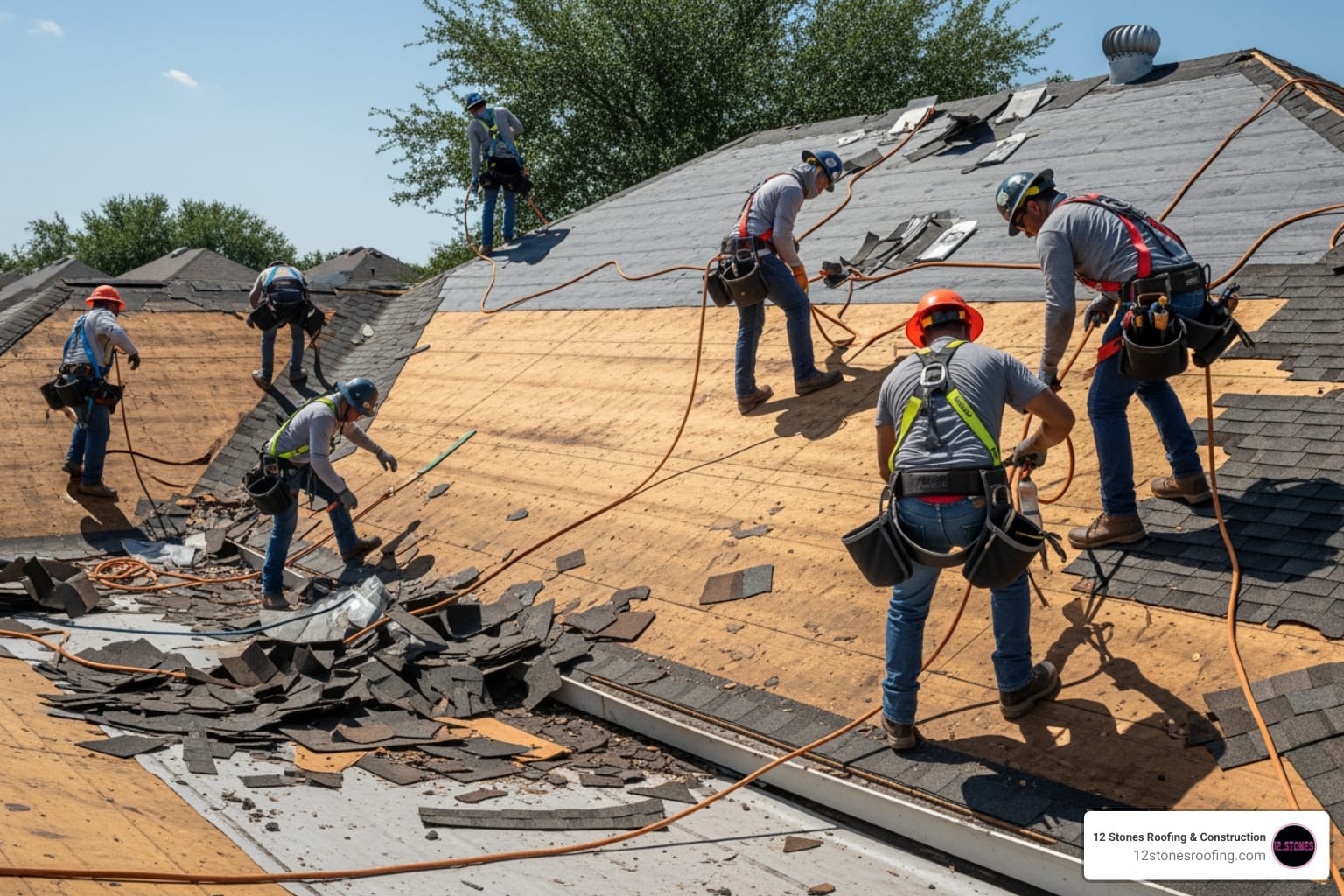

Slate Shingle Installation in Texas: 2026 Cost, Lifespan, and the Storm-Grade Install Checklist
Slate shingle installation Texas homeowners choose is the longest-lasting, most weather-resistant roofing system available in the residential market. According to the National Roofing Contractors Association, natural slate roofs achieve a verified service life of 100 to 200 years—outperforming every other residential roofing material by a factor of five or more. Slate is non-combustible, absorbs less than 0.25% moisture, and delivers Class A fire and Class 4 impact ratings when installed to ASTM C406 standards. For Texas homeowners in the Gulf Coast hail-and-wind corridor, these numbers matter. If you’re considering a premium roofing upgrade, 12 Stones Roofing & Construction provides expert evaluations covering structure, underlayment, flashing, and material selection for homes across Pasadena and the greater Houston metro.
Here are the numbers most Texas homeowners compare first:
| Factor | Natural Slate | Synthetic Slate (e.g., F-Wave) |
|---|---|---|
| Cost per sq ft | $20 – $30 | $12 – $25 |
| Lifespan | 100 – 200 years | 50+ years |
| Weight per 100 sq ft | 800 – 1,500 lbs | 200 – 400 lbs |
| Fire Rating | Class A | Class A |
| Impact Rating | High | Class 4 |
| Wind Resistance | High | Up to 130 mph |
| Maintenance Cycle | Every 3 years | Every 3 years |
Texas weather is brutal. Hail storms, high winds, and intense heat put every roof through its paces. Slate—both natural and synthetic—delivers Class A fire performance, low water absorption, and impact resistance that standard asphalt shingles cannot match over the long term.
The challenge is that slate installation is specialized. A slate roof engineered to last a century can fail within a decade if headlap, nail placement, flashing metals, or deck prep are wrong.
That’s why choosing the right contractor matters as much as choosing the right material. At 12 Stones Roofing & Construction’s slate roofing division, we’ve helped Pasadena and Gulf Coast homeowners navigate exactly this decision—from material selection to structural assessment to final installation.
I’m Jason Roberts, owner of 12 Stones Roofing & Construction and a Service-Disabled Veteran with over a decade of hands-on experience in residential and commercial roofing across the Gulf Coast region, including slate shingle installation Texas projects for homeowners dealing with storm damage and aging roofs. In this guide, I’ll walk you through costs, structural requirements, installation steps, and what to watch out for so you can make a confident, informed decision. Call us directly at [(713) 818-1612] to discuss your project.
Why Slate Roofing Outperforms Every Alternative in the Texas Climate
When we talk about Slate shingle installation Texas, we aren’t talking about an ordinary roof—we are talking about a geological shield for your home. Natural slate is a fine-grained metamorphic rock, most commonly sourced from quarries in Vermont, where deposits date back 500 million years. Because it is literal stone, it possesses thermal, fire, and moisture properties that manufactured materials cannot replicate.
One of the most significant advantages for homeowners in Pasadena and La Porte is slate’s exceptional thermal mass. The U.S. Department of Energy notes that roofing materials with high thermal mass reduce peak cooling loads by absorbing and slowly releasing heat. Texas summers routinely exceed 100°F, baking standard attics to 150°F or more. Slate’s density moderates this heat transfer, potentially lowering cooling costs by 10–15% compared to lightweight asphalt systems. Furthermore, slate is completely fireproof—it will not ignite, spread flame, or produce toxic smoke under any conditions.
Our team at 12 Stones Roofing & Construction provides comprehensive slate roofing services that emphasize these natural benefits. Unlike wood or asphalt, slate absorbs less than 0.25% moisture by weight (per ASTM C406 Grade S1 standards), meaning it won’t rot, harbor mold, or suffer from algae streaks—a common sight on humid Gulf Coast roofs.

Performance Ratings That Define Slate Shingle Installation Texas Success
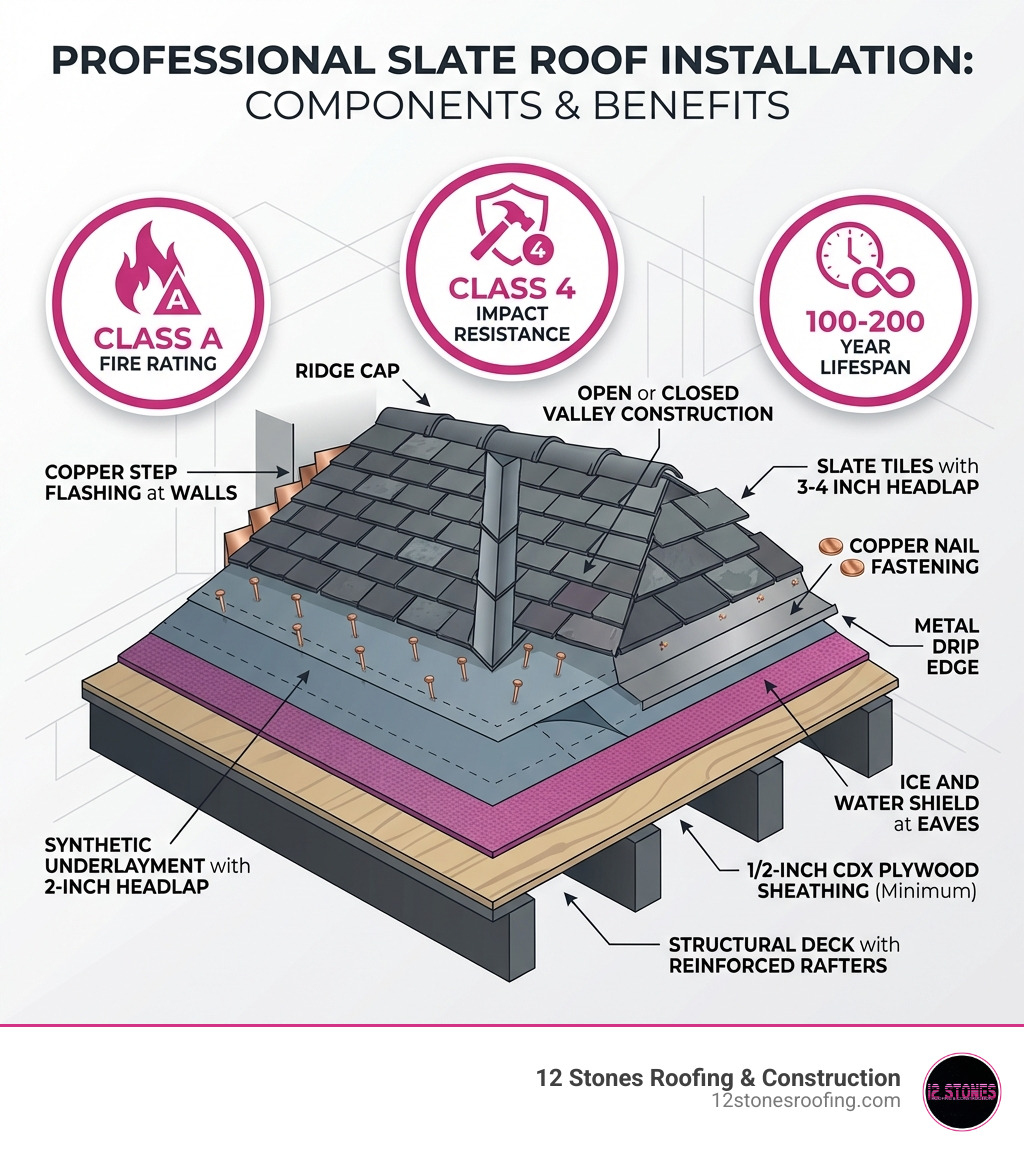
In roofing, performance ratings are survival metrics, not marketing language. For a Slate shingle installation Texas project to deliver its full lifespan, the materials must meet these rigorous, independently verified standards:
- Class A Fire Rating (ASTM E108): The highest level of fire resistance available. Slate prevents flame penetration into the attic, providing critical protection during dry Texas summers when wildfire risk increases.
- Class 4 Impact Resistance (UL 2218): The “hail-proof” gold standard. To achieve this rating, a shingle must withstand a 2-inch steel ball dropped from 20 feet without cracking. Many high-end synthetic slates, like F-Wave, carry this certification. According to the Insurance Institute for Business & Home Safety (IBHS), Class 4 rated roofs can qualify homeowners for insurance premium discounts of 10–28% in hail-prone states like Texas.
- 130 MPH Wind Rating (ASTM D3161): Texas storms produce straight-line winds and tornadoes regularly. Proper installation ensures your slate stays secured even at hurricane-force speeds.
- ASTM C406 Grade S1: For natural slate, Grade S1 certification guarantees a minimum service life of 75 years, water absorption below 0.25%, and a modulus of rupture exceeding 9,000 psi. The full SRCA installation guidelines detail the technical depth required for these systems.
Longevity and Long-Term Financial Value
Slate is a century-long investment backed by verifiable data. A correctly installed natural slate roof in Texas lasts between 100 and 200 years. By comparison, the average asphalt shingle roof in the Gulf Coast region requires full replacement every 15 to 20 years due to UV degradation, hail damage, and thermal cycling.
Over a 100-year period, a homeowner with asphalt shingles will spend approximately $75,000–$120,000 on five to seven roof replacements. A single slate installation at $35,000–$55,000 eliminates that cycle entirely. This longevity also increases property resale value—homes with slate roofs command a 6–10% premium according to data from the National Association of Realtors, making slate a favorite for luxury homes across the Houston metro area.
Natural vs. Synthetic Slate: The Critical Decision for Texas Homeowners
The biggest fork in the road for homeowners is deciding between natural stone and modern synthetic alternatives. Natural slate offers unmatched authenticity and a 150+ year lifespan, but it weighs 800–1,500 pounds per square and costs more upfront. Synthetic slate, such as F-Wave Classic Slate, uses commercial-grade polymers to replicate the look of stone at a lower price point and roughly 75% less weight.
If your home is reaching the point where it needs a complete system upgrade, weigh these factors carefully:
| Feature | Natural Slate | Synthetic Slate |
|---|---|---|
| Material | Metamorphic Rock | Polymer/Composite |
| Weight | 800 – 1,500 lbs per square | 200 – 400 lbs per square |
| Durability | Fragile to walk on, lasts 100+ years | Very durable underfoot, lasts 50+ years |
| Maintenance | Requires specialist craftsman | Low maintenance, standard roofer |
| Insurance Discount Eligibility | Varies by carrier | Class 4 = 10–28% discount |
2026 Cost Breakdown for Slate Shingle Installation Texas
Here are the verified cost ranges for Slate shingle installation Texas projects based on 2024–2025 Gulf Coast market data:
- Natural Slate: Expect to pay between $20 and $30 per square foot installed. Labor is more intensive because each tile must be hand-fitted, punched, and fastened with copper nails by a trained craftsman. Total project cost for a 2,000 sq ft roof: $40,000–$60,000.
- Synthetic Slate: Options like F-Wave typically range from $12 to $25 per square foot installed. Single-piece construction simplifies the installation process, reducing labor costs to approximately $3 to $7 per square foot. Total project cost for a 2,000 sq ft roof: $24,000–$50,000.
While synthetic is cheaper upfront, natural slate wins the long-term cost analysis because it can outlast three or four synthetic roof cycles without replacement.
Aesthetic Styles and Installation Patterns
One of the joys of slate is its design versatility. You aren’t limited to a single look. We customize installations using several proven patterns:
- Standard Uniform: All slates are the same length and width, laid in even horizontal rows for a clean, formal appearance.
- Staggered Butt: Slates of varying lengths create an uneven, textured look at the bottom edge—popular for historic and cottage-style homes.
- Graduated Lengths: Larger, thicker slates are placed at the eaves, with progressively smaller tiles toward the ridge. This creates an architectural perspective that makes the roof appear taller and more imposing.
- Color Blending: Natural slate comes in greys, greens, purples, blacks, and reds depending on quarry origin. Blending tiles from multiple pallets ensures a natural, non-blotchy appearance that improves with age.
Structural Requirements and Weight Engineering for Texas Slate Roofs
Before ordering the first tile, we evaluate your home’s structural capacity. Natural slate is heavy—800 to 1,500 pounds per 100 square feet (one “square”). For context, standard three-tab asphalt shingles weigh approximately 250 pounds per square, meaning natural slate can impose 3–6 times the dead load on your framing system.
The International Residential Code (IRC) Section R802 requires that roof framing support all anticipated dead and live loads. If your home wasn’t originally designed for slate, you cannot simply swap materials without engineering review. We always perform professional structural evaluations before recommending slate installation.
Structural Load Requirements:
- Rafter Reinforcement: We may need to add “sister” rafters (doubling existing members) to handle the increased dead load. A structural engineer’s stamp is required for permit approval in most Texas jurisdictions.
- Decking: Slate demands a solid foundation. We require a minimum of 1/2″ CDX plywood or 1-inch nominal solid wood boards. Thin OSB panels often lack the nail-holding capacity and rigidity needed for heavy slate.
- Fastener Pull-out Resistance: The deck must be thick enough for copper nails to penetrate at least 3/4 inch into solid wood, ensuring adequate pull-out resistance against wind uplift forces.
Deck Preparation and Underlayment Systems
The underlayment is the secondary waterproofing barrier that protects the deck if any slate tile is damaged or displaced. For Slate shingle installation Texas projects, we never use standard 15-lb felt paper. We specify high-performance synthetic underlayment or self-adhering ice and water shields rated for the full service life of the slate.
- Eave Protection: We apply self-adhering ice and water shield membrane at the eaves extending a minimum of 24 inches past the interior wall line to prevent moisture backup from wind-driven rain.
- Ventilation: Proper airflow prevents condensation damage to the deck from below. We follow FHA and IRC standards, ensuring at least 1 sq ft of net free attic vent per 150 sq ft of attic floor area (or 1:300 with balanced intake and exhaust). This prevents the 150°F+ attic temperatures that can delaminate plywood and degrade underlayment prematurely.
For homeowners in the Pasadena, TX area, our team handles every phase of structural assessment and deck preparation before a single slate tile is installed.
Step-by-Step Professional Slate Shingle Installation Texas Process
Installing slate is closer to masonry than conventional roofing. It demands precision, patience, and a “measure twice, cut once” discipline that separates qualified craftsmen from general contractors.
- Chalk Line Layout: We mark vertical lines every 12 inches and horizontal lines based on the calculated “exposure” (the visible portion of each slate tile).
- Starter Course Installation: A dedicated “starter” row is laid at the eave with the long dimension running vertically to provide a solid base and proper offset for the first field course.
- Headlap Requirements: Headlap is the single most critical technical detail in slate installation. Headlap is the distance the bottom edge of the third course overlaps the top edge of the first course. In Texas, we use a 3-inch headlap for standard slopes (8:12 and above) and a 4-inch headlap for lower slopes (between 4:12 and 8:12). Insufficient headlap is the number one cause of premature slate roof failure.
- Fastening Protocol: Each slate receives a minimum of two nails. Nails must be driven flush with the slate surface but never overdriven. An overdriven nail cracks the slate. An underdriven nail allows the tile to rattle and eventually blow off in high winds.
For additional technical specifications, the Slate/Select installation manual details the precision required for both natural and synthetic stone systems.
Precision Fastening and Flashing Details
We exclusively use 11-gauge copper nails or 316 stainless steel fasteners for every slate project. The reason is simple: a slate roof lasts 100+ years, and standard galvanized nails corrode and fail within 20–30 years in the humid Gulf Coast environment. Your fasteners must match the lifespan of the stone they secure.
- Valley Construction: We prefer “open valleys” lined with 16 oz. copper sheet (minimum 18-inch width). Open valleys allow debris and heavy Texas rainfall—which can exceed 5 inches per hour during tropical events—to flow freely without backing up under the tiles.
- Step Flashing: Every roof-to-wall intersection receives individual copper step flashing pieces woven into each slate course. This creates a continuous, watertight seal that moves independently with thermal expansion.
Specialized Hand Tools for Slate Craftsmen
Professional slate installation requires hand tools, not pneumatic nail guns. Compressed-air fasteners crack natural slate and cannot achieve the precise countersink depth required:
- Slate Cutter: A guillotine-style tool for trimming tiles to fit valleys, hips, and rakes.
- Slate Hammer: Features a pointed claw for punching nail holes from the back of the tile, creating a natural countersink that seats the nail head flush.
- Slate Ripper: A long, flat tool slid under installed slates to cut nails during individual tile repairs without disturbing adjacent courses.
If you are looking for expert roofers near Houston who own and use these specialized tools daily, call us at (713) 818-1612.
Maintenance Schedule and Storm Resilience: Protecting a Century-Long Investment
Even a roof engineered to last 200 years requires periodic inspection. We recommend a professional maintenance inspection at minimum once every three years. In Pasadena and La Porte, the most common failure points are not the slate tiles themselves but the “soft” components—flashing, sealants, and underlayment around penetrations like chimneys and vents.
Essential Maintenance Tasks:
- Post-Storm Hail Damage Assessment: After any hailstorm producing stones 1 inch or larger, we inspect for “bruised” or cracked slates. Natural slate resists most hail, but a direct hit from 2-inch+ hailstones (common in Texas supercell events) can fracture individual tiles.
- Flashing Integrity Check: We examine all copper flashing for pitting, sealant degradation, or displacement caused by thermal cycling.
- Algae and Moss Removal: While slate’s low porosity resists biological growth, shaded north-facing sections in humid Gulf Coast climates can develop moss. Gentle low-pressure cleaning restores appearance without damaging the stone surface.
- Gutter and Drainage Verification: Clogged gutters cause water to back up under eave-course slates, accelerating underlayment deterioration.
If you suspect storm damage, our expert roof repair and restoration services can help you document the damage, navigate the insurance claims process, and ensure repairs meet the original installation standards.
How Damaged Slate Tiles Are Replaced Without Full Tear-Off
One of slate’s greatest practical advantages is its modularity. If one tile cracks, you replace that single tile—not the entire roof. We use the “hidden bib” or slate hook method: a copper or stainless steel hook is fastened to the deck between the surrounding slates, and a new color-matched tile slides into position and rests on the hook. This technique requires no disturbance to adjacent courses. We always source replacement tiles from the original quarry whenever possible to ensure an exact color and thickness match.
Frequently Asked Questions About Slate Shingle Installation Texas
How long does a slate roof last in Texas?
A natural slate roof installed with proper underlayment, copper fasteners, and correct headlap lasts 100 to 200 years. This is verified by the Slate Roofing Contractors Association and supported by hundreds of existing slate roofs in the northeastern United States that have exceeded 150 years of service. Synthetic options like F-Wave are engineered to last 50+ years and typically include manufacturer warranties covering hail damage for the first five years.
Can my existing roof structure support the weight of natural slate?
Most modern Texas homes are framed for asphalt shingles at approximately 250 lbs per square. Natural slate weighs 800 to 1,500 pounds per square—3 to 6 times heavier. A licensed structural engineer must evaluate your rafters, load paths, and foundation before installation. In many cases, sister rafters or additional bracing can bring the structure into compliance without major reconstruction.
Is synthetic slate more hail-resistant than natural stone?
In impact testing, synthetic slate often outperforms natural stone against hail. Natural slate can crack under extreme point-load impact, while synthetic slates are manufactured from flexible polymers engineered to absorb and redistribute force. Many synthetic products carry a Class 4 Impact Rating (UL 2218), the highest available classification, which qualifies homeowners for insurance premium reductions of 10–28% in Texas.
What is the total cost of a slate roof on a 2,000 sq ft Texas home?
For natural slate, expect a total installed cost of $40,000–$60,000. For synthetic slate, the range is $24,000–$50,000. These figures include structural assessment, deck preparation, underlayment, flashing, materials, and labor. While the upfront investment is 2–4 times higher than asphalt, the elimination of repeated replacements makes slate the lowest-cost option over a 50+ year ownership horizon.
How do I file an insurance claim for slate roof hail damage in Texas?
Document the damage with dated photographs, request a professional inspection report from a qualified slate roofer, and file the claim with your carrier within the policy’s reporting window (typically 1–2 years in Texas). Homes with Class 4 rated roofing materials often receive faster claim processing and may qualify for reduced deductibles. Our team at 12 Stones Roofing assists homeowners through every step of this process.
Conclusion: Build the Last Roof Your Texas Home Will Ever Need
A Slate shingle installation Texas project is a definitive investment in your home’s structural integrity, energy efficiency, and long-term value. Whether you choose natural Vermont slate with its 100–200 year proven lifespan or high-tech synthetic polymer shingles rated Class 4 for impact and 130 mph for wind, you are installing a roof system that eliminates the costly 15–20 year replacement cycle that defines asphalt roofing in the Gulf Coast region.
At 12 Stones Roofing & Construction, we bring local expertise, specialized hand-tool craftsmanship, and a veteran’s attention to detail to every slate project. From Pasadena to La Porte to the greater Houston metro, we ensure your roof isn’t just a covering—it’s a lifetime asset backed by verifiable performance data and installed to the highest industry standards.
Ready to upgrade to the “forever roof”? Schedule your expert slate roofing consultation today or call us directly at (713) 818-1612 to discuss your project and get a detailed estimate.