
What to Look for in EPDM Roofing Contractors Before You Sign Anything
EPDM roofing contractors are specialists who install, repair, and maintain synthetic rubber membrane roofs — most commonly on flat and low-slope commercial or residential buildings. When you need professional roofing services to protect your investment, understanding the qualifications of your installer is the first step toward a leak-free future. EPDM is a powerhouse of durability, but its performance depends entirely on the precision of the installation.
If you need a quick answer on what to look for, here it is:
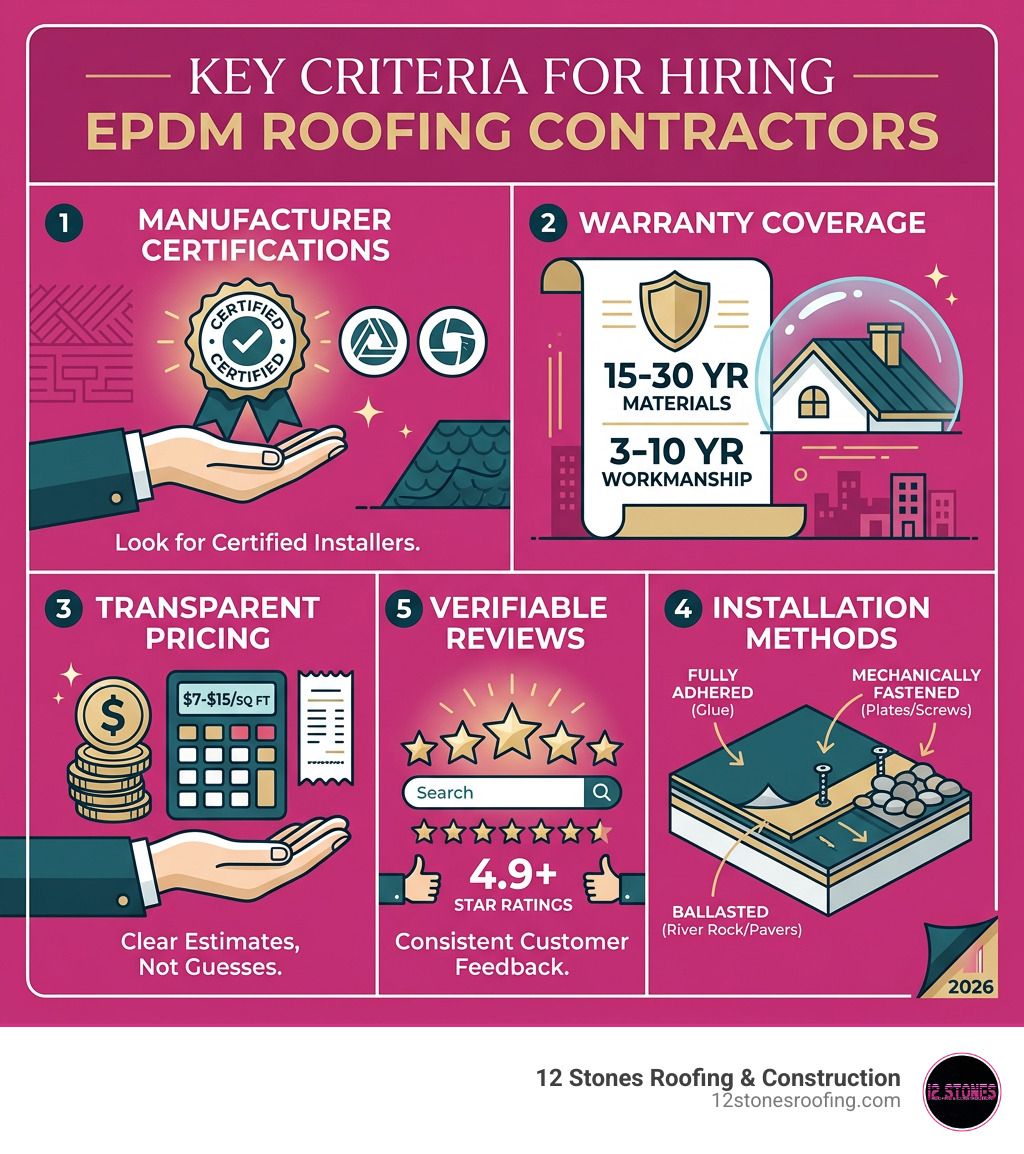
Top things to check when hiring EPDM roofing contractors:
- Manufacturer certifications — Look for contractors certified by major EPDM brands (e.g., Firestone, Carlisle)
- Verifiable reviews — Aim for contractors with consistent 4.9+ star ratings across multiple platforms
- Warranty coverage — Expect 15-30 years on materials and at least 3-10 years on workmanship
- Experience with installation methods — They should know fully adhered, mechanically fastened, and ballasted systems
- Transparent pricing — Typical costs run $7-$15 per square foot depending on thickness and complexity
- Local climate knowledge — Critical for Gulf Coast properties facing heat, humidity, and storm exposure
A flat roof that fails isn’t just an inconvenience. In Texas, a single storm season can turn a small leak into a flooded interior, mold damage, and a five-figure repair bill. Choosing the wrong contractor — one who cuts corners on seams or skips proper surface prep — is often how property owners end up in that situation.
The good news: EPDM is one of the most proven flat roofing systems available. With proper installation, it can last 25 to 50 years. The challenge is finding a contractor who actually knows how to install it correctly.
I’m Jason Roberts, owner of 12 Stones Roofing & Construction — a Service-Disabled Veteran-Owned firm based in Pasadena, Texas, with over a decade of hands-on experience installing and repairing EPDM roofing systems for commercial and residential clients across the Gulf Coast. In this guide, I’ll walk you through everything you need to evaluate EPDM roofing contractors with confidence, so you don’t end up with a roof — or a contractor — that lets you down.
Epdm roofing contractors terms to remember:
Understanding EPDM: The “Rubber Roof” Standard for Durability
When we talk about EPDM, we are referring to Ethylene Propylene Diene Monomer. It sounds like a mouthful, but in the industry, we simply call it “rubber roofing.” This synthetic rubber membrane has been a staple in the United States for decades because it is incredibly tough, flexible, and resistant to the elements.
EPDM is manufactured from oil and natural gas derivatives, often incorporating recycled materials like tires, sawdust, and slate dust. This makes it one of the most eco-friendly and cost-effective options for flat roof material types. Its primary superpower is its ability to handle thermal expansion. In a place like Pasadena or La Porte, where the sun beats down all day and a sudden thunderstorm can drop temperatures by 20 degrees in minutes, your roof needs to stretch and contract without cracking. EPDM does this better than almost any other material.
According to the EPDM Roofing Association, the material is highly resistant to UV radiation, ozone, and extreme weather. It remains pliable in temperatures ranging from -40°F to 300°F. For more technical details, you can explore our breakdown of EPDM rubber roofing materials.
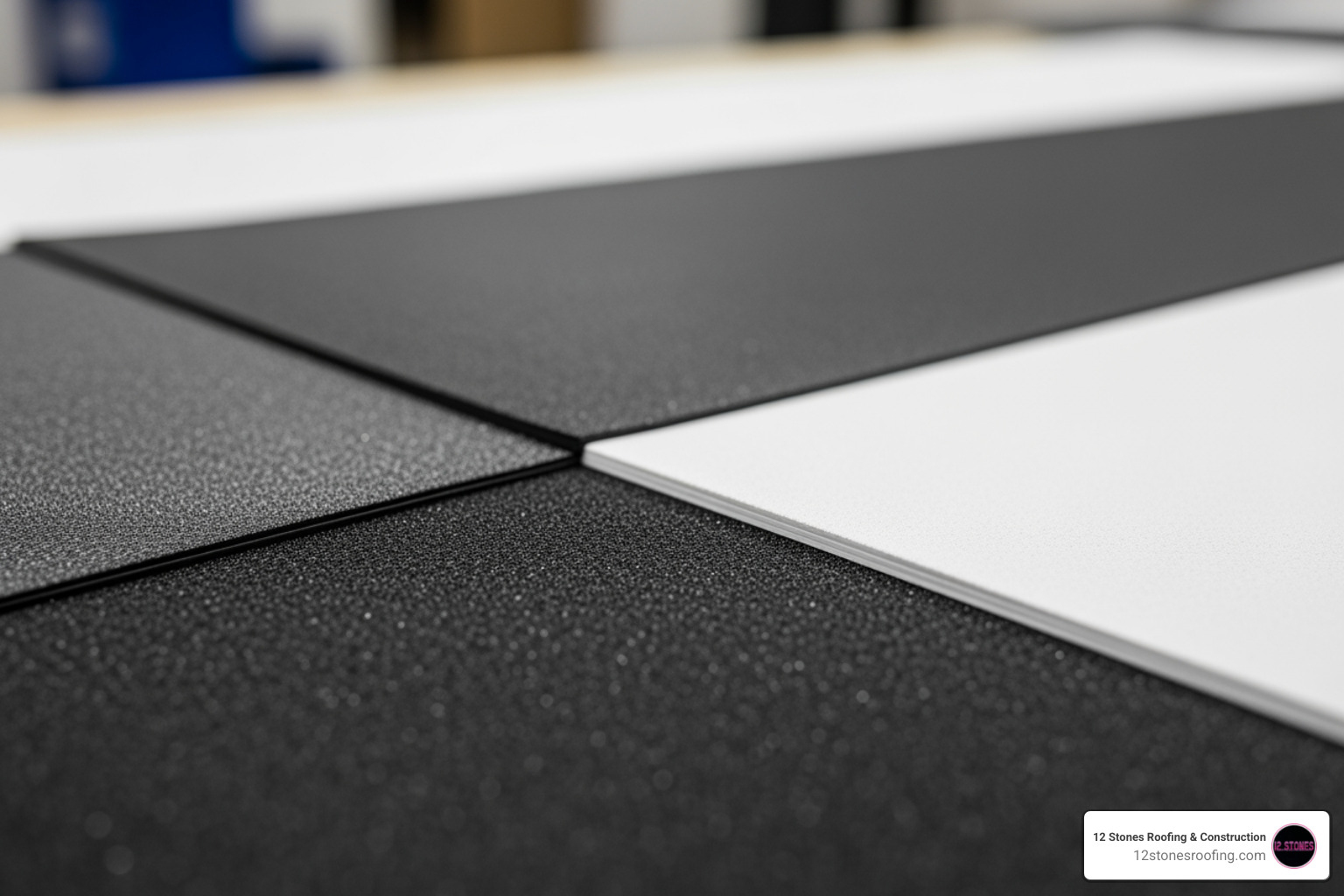
The Difference Between Black and White EPDM Membranes
One of the first questions EPDM roofing contractors will ask you is whether you want a black or white membrane.
- Black EPDM: This is the traditional choice. It contains “carbon black,” which acts as a UV stabilizer. It is excellent for absorbing heat, which is a major plus in colder climates but can increase cooling costs in Texas.
- White EPDM: This is essentially a black membrane with a white top layer (often titanium dioxide) or a reflective coating. It reflects solar heat, which can significantly lower energy bills for air-conditioned buildings in our area.
Suitability for Different Climates and Roof Types
EPDM is versatile. While it is the “gold standard” for commercial flat roofs, it is also an excellent choice for residential low-slope areas like porches, patios, or garages. Because the rubber can easily contour to complex shapes, it provides a seamless-looking finish even on roofs with multiple penetrations like vents or HVAC units. Whether you are managing a warehouse in La Porte or a home in Pasadena, EPDM provides a waterproof barrier that stands up to the heavy rainfall common on the Gulf Coast.
Why Professional EPDM Roofing Contractors Recommend This System
As EPDM roofing contractors, we often recommend this system because of its “proven” status. While newer materials like TPO and PVC are popular, EPDM has a track record spanning over 50 years.
Comparing EPDM to TPO, PVC, and Built-Up Roofing
When choosing a flat roof, you’re usually looking at a few main contenders. Here is how they stack up:
| Feature | EPDM (Rubber) | TPO (Thermoplastic) | PVC (Vinyl) | Built-Up (BUR) |
|---|---|---|---|---|
| Primary Benefit | Durability & Cost | Heat Reflection | Chemical Resistance | Multi-layer Strength |
| Installation | Adhesive/Fasteners | Heat-welded seams | Heat-welded seams | Hot tar/Gravel |
| Flexibility | Extremely High | Moderate | Moderate | Low |
| Lifespan | 25–50 Years | 15–25 Years | 20–30 Years | 15–20 Years |
EPDM is generally the most flexible of the bunch. While TPO and PVC rely on heat-welded seams, EPDM uses high-strength adhesives or specially formulated tapes. This makes EPDM very easy to repair compared to older built-up roofs that require heavy equipment and hot tar.
Lifespan Statistics and Performance Data
The longevity of an EPDM system is its biggest selling point. Research shows that professionally installed systems typically last between 12 and 25 years, but with routine maintenance, many reach the 40 to 50-year mark.
Thickness matters here. Most EPDM roofing contractors offer three standard thicknesses:
- 45 mil: The budget-friendly entry point.
- 60 mil: The industry standard for most commercial applications.
- 90 mil: The “heavy-duty” option, providing superior resistance to hail and punctures.
In our experience in the Pasadena area, opting for at least a 60 mil membrane provides the best balance of cost and protection against the wind-blown debris and occasional hail we see in Texas.
Installation Methods and Cost Factors
How your roof is put together is just as important as the material itself. There are three primary ways EPDM roofing contractors will secure the membrane to your building.
What to Expect from EPDM Roofing Contractors During Installation
- Fully Adhered System: The membrane is glued directly to the substrate or insulation using a special contact cement. This is our preferred method for the Gulf Coast because it offers the highest wind uplift resistance. It looks the cleanest and lasts the longest.
- Mechanically Fastened: The membrane is attached using large screws and plates that go through the insulation into the roof deck. This is a faster, more affordable method, but it can allow the membrane to “flutter” in high winds.
- Ballasted: The EPDM is laid down loosely and held in place by large stones or pavers. While this is great for fire resistance and aesthetics, it adds a massive amount of weight to the structure.
The process starts with rigorous surface preparation. Any moisture trapped under the new membrane will lead to blistering and failure. We then roll out the large sheets (which can be up to 50 feet wide to minimize seams), apply the adhesive, and use specialized rollers to ensure a 100% bond. For projects in our service area, check out our flat roofing in Pasadena page for local project examples.
Understanding Installation Costs and Re-Roofing Options
On average, EPDM installation costs range from $7 to $15 per square foot. Several factors influence where you fall on that scale:
- Thickness: 90 mil costs more than 45 mil.
- Method: Fully adhered is more labor-intensive (and expensive) than mechanically fastened.
- Complexity: Roofs with many pipes, skylights, or AC units require more detailed flashing work.
- Tear-off vs. Recover: In many cases, we can install EPDM over an existing roof (a “recover”), which saves you thousands in disposal fees. However, if the old roof is saturated with water, a full tear-off is mandatory to protect your building’s structural integrity.
Maintenance and Identifying Common Issues
EPDM is low-maintenance, but it isn’t “no-maintenance.” To get that 40-year lifespan, you need to keep an eye on a few things. We recommend bi-annual inspections—once in the spring and once in the fall—to clear debris and check the critical “weak points” of the system.
Identifying Leaks, Seam Failures, and Ponding Water
Most common problems with EPDM roofing don’t happen in the middle of the sheet; they happen at the seams and edges.
- Seam Failures: Over time, adhesives can dry out or pull apart due to “shrinkage.” If you see a seam lifting, it needs to be taped immediately.
- Punctures: While rubber is tough, a dropped tool or a sharp branch can create a tear.
- Ponding Water: If water sits on your roof for more than 48 hours after a rain, it can put extra stress on the seams.
- Shrinkage: EPDM has a natural tendency to shrink slightly over decades. If not installed with proper “perimeter securement,” it can pull away from the walls.
If you suspect a leak but can’t see the source, we use infrared moisture scanning to find water trapped beneath the surface that hasn’t dripped through the ceiling yet. Early detection is the key to a leaky flat roof repair that doesn’t break the bank.
Professional Services: Repair, Restoration, and Maintenance
If your EPDM roof is 15-20 years old and starting to show its age, you might not need a replacement. EPDM restoration involves cleaning the surface, repairing the seams, and applying a liquid rubber coating. This can extend the life of your roof by another 10 to 20 years at a fraction of the cost of a new installation.
How to Vet and Hire Reliable EPDM Roofing Contractors
Hiring the right team is the difference between a roof that lasts 40 years and one that leaks in 40 days. In the UK, platforms like TrustATrader show an average rating of 5.0/5 for vetted EPDM installers, proving that specialized expertise matters. Here in Texas, you need to do your own homework.
Vetting EPDM Roofing Contractors for Long-Term Reliability
- Check Credentials: Are they insured? Do they follow OSHA safety guidelines? A contractor who doesn’t care about their crew’s safety likely won’t care about your roof’s seams.
- Local Expertise: A contractor from out of state might not understand the specific wind-load requirements for La Porte or Pasadena.
- Manufacturer Certifications: Brands like Carlisle or Firestone only certify contractors who have proven they can install the product to their strict standards.
- Transparent Bidding: Your quote should include labor, materials, insulation, and disposal. No “hidden fees” halfway through the job.
For more tips, read our flat roofing contractors complete guide.
Understanding Material and Workmanship Warranties
Don’t just ask “is there a warranty?” Ask what it covers.
- Material Warranty: Usually 15–30 years. This covers defects in the rubber itself.
- Workmanship Warranty: Usually 5–10 years. This covers leaks caused by how the contractor installed the roof.
- NDL Warranty: “No Dollar Limit” warranties are the gold standard. If the roof fails, the manufacturer pays for the full repair or replacement, regardless of the cost. These are typically only available through certified EPDM roofing contractors.
Frequently Asked Questions about EPDM Roofing
How long does an EPDM roof typically last?
A professionally installed EPDM roof typically lasts 25 to 35 years. However, many systems that receive regular maintenance and are installed with thicker membranes (60 or 90 mil) have been known to exceed 40 or 50 years of service.
Can EPDM be installed over an existing roof?
Yes, this is often called a “re-cover.” As long as the existing roof structure is sound and there isn’t significant moisture trapped in the old insulation, we can install a new EPDM membrane over the old system. This reduces labor costs and keeps old roofing material out of Texas landfills.
Is black or white EPDM better for my building?
In the Pasadena and La Porte areas, white EPDM is often preferred for air-conditioned buildings because it reflects the intense Texas sun, lowering cooling costs. However, black EPDM is slightly more durable over the long term because the carbon black provides superior UV protection. We can help you weigh the energy savings against the long-term durability based on your specific building.
Conclusion
EPDM roofing is a powerhouse of durability, offering a flexible, waterproof, and long-lasting solution for any flat or low-slope building. But the material is only half the battle. To ensure your investment pays off over the next four decades, you need EPDM roofing contractors who prioritize proper surface prep, precision seam work, and local safety standards.
At 12 Stones Roofing & Construction, we take pride in protecting our neighbors’ properties with the highest quality rubber roofing systems. Whether you need a minor repair, a full restoration, or a brand-new installation, we are here to ensure you are never left high and dry.
For more information or to schedule a professional inspection, visit our professional EPDM roofing services page today.