
Understanding Your Policy: RCV vs. ACV and Deductibles
Before you pick up the phone to call your agent, you must understand the “language” of your policy. Not all coverage is created equal, and the difference between two common acronyms—RCV and ACV—can mean a gap of $5,000 to $10,000 in your pocket.

Replacement Cost Value (RCV)
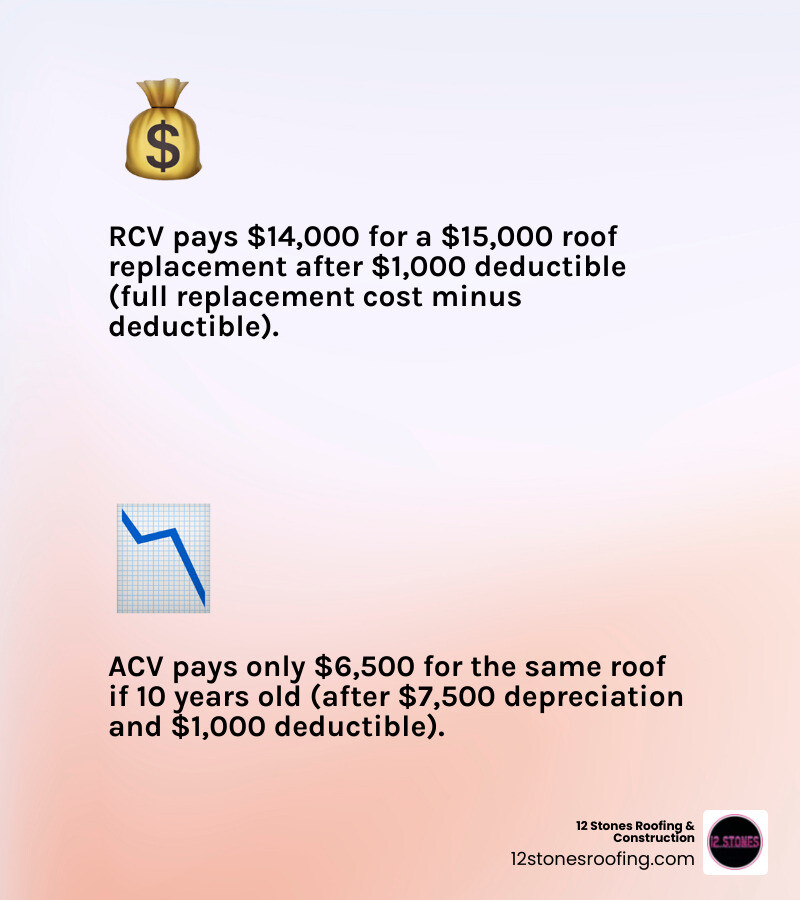
An RCV policy is the gold standard for homeowners. If your roof is damaged by a covered peril, the insurance company pays the cost to replace it with a brand-new roof of similar quality at today’s market prices, minus your deductible. According to Insurance Information Institute guidance on roof coverage, most standard policies cover sudden and accidental damage, but the payout method depends entirely on this distinction.
Actual Cash Value (ACV)
An ACV policy factors in depreciation. Think of it like a car; the moment you drive it off the lot, it loses value. If you have a 15-year-old roof with a 30-year lifespan, an ACV policy will only pay for the “remaining” value of that roof. In 2025, ACV insurance policies are often calculated at approximately 20% to 25% less than a replacement cost policy due to this depreciation.
The Impact of Deductibles on Your Payout
Your deductible is the specific amount you agree to pay out-of-pocket before your insurance coverage kicks in. In Texas, specifically for wind and hail damage, deductibles are often not a flat dollar amount (like $500 or $1,000) but a percentage of your home’s total insured value (Coverage A).
Commonly, these range from 1% to 5%. If your home is insured for $300,000 and you have a 2% wind/hail deductible, you are responsible for the first $6,000 of the repair. It is vital to check more info about roofing insurance claims to see how these numbers apply to your specific situation in Pasadena or La Porte.
Why ACV Policies Cost More in the Long Run
While ACV policies often have lower monthly premiums, the “savings” vanish the moment a storm hits. If you are facing a $12,000 roof replacement but your ACV payout is only $4,000 after depreciation and your deductible, you are left to bridge an $8,000 gap. Furthermore, failing to replace a roof after an ACV claim can lead to policy cancellation or the exclusion of future roof coverage. For more details on these risks, you can consult the NAIC consumer insurance resources.
Essential Steps for an Insurance Claim Roof Repair
Timing is everything in insurance. In Texas, we see everything from “pea-sized” hail that does nothing to “softball-sized” hail that destroys shingles instantly.
Step 1: Immediate Assessment and Protection
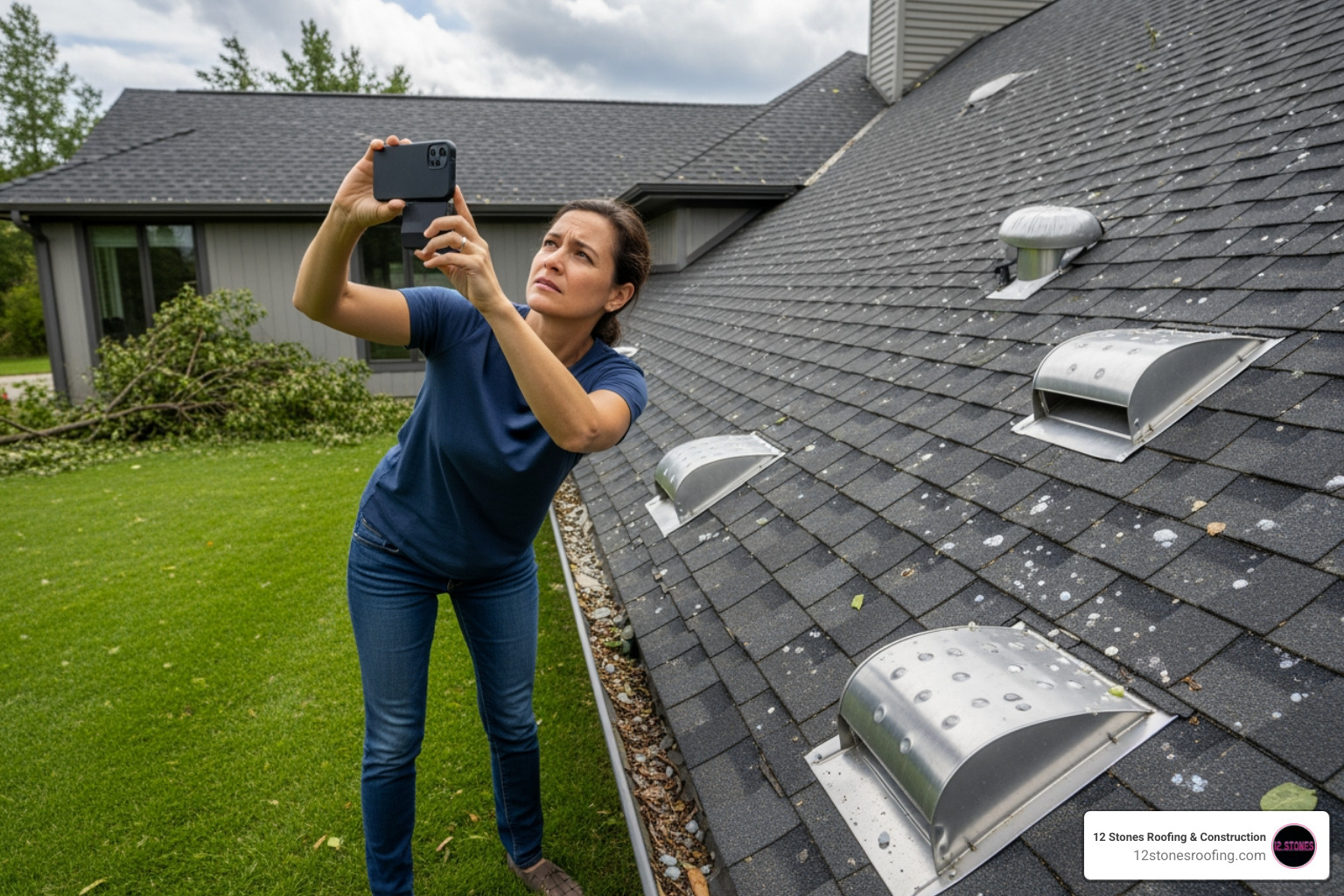
Once it is safe to go outside, do a ground-level visual check. Do you see shingles in the yard? Are the metal “vents” on your roof dented? If you have active leaks, you have a “duty to mitigate” further damage. This means you should arrange for Emergency Roof Tarping immediately. Keep your receipts! These temporary repair costs are typically reimbursable as part of the claim.
Step 2: Professional Documentation
The Texas Department of Insurance deductible guidance emphasizes that homeowners should document everything before making permanent repairs.
- Photos: Take wide shots of the house and close-ups of specific damage.
- Video: Walk through your home and record any interior water stains on ceilings or walls.
- Context: If there is hail on the ground, take a photo of it next to a ruler or a coin for scale.
Step 3: Schedule a Professional Roof Inspection
Before you file the official claim, have a local expert perform a Professional Roof Inspection. A trained roofer knows how to spot “bruised” shingles that look fine to the untrained eye but will fail in six months. We can provide a detailed report that serves as a roadmap for the insurance adjuster.
Step 4: Working with the Insurance Adjuster
The insurance company will send an adjuster (or use aerial imagery/drones) to verify the loss. We strongly recommend having your roofing contractor present during this meeting. Adjusters are often handling dozens of claims a day; a contractor acts as your advocate to ensure no damage is overlooked. This collaborative approach is supported by organizations like GAF, who provide storm restoration training for professionals to ensure assessments are accurate and fair.
The Role of a Professional Contractor in the Claims Process
Many homeowners think the contractor’s job starts only when the shingles arrive. In reality, a great contractor is your partner from day one.
Expert Advocacy and Supplementing
Insurance estimates are often “initial” estimates. Once work begins, we may find “decking” (the wood under the shingles) that is rotted and needs replacement to meet local Pasadena building codes. We handle the “supplementing” process—submitting additional evidence to the insurer to ensure these necessary costs are covered. This is a critical part of a Roof Inspection for Insurance.
Maximizing Your Settlement
If you have an RCV policy, the payout usually comes in two checks. The first is for the ACV (the depreciated value). The second check, called “recoverable depreciation,” is released only after the work is completed and an invoice is sent to the insurer. Our Roof Replacement Services include managing this paperwork so you aren’t left wondering where the rest of your money is.
Avoiding “Storm Chasers” and Fraud
After a big storm in La Porte or Pasadena, you’ll see trucks with out-of-state plates knocking on doors. These are “storm chasers.” They often do sub-par work and disappear before the warranty is ever needed.
Crucial Warning: In Texas, it is a Class A misdemeanor for a contractor to “waive” or “absorb” your insurance deductible. If a contractor offers to “cover your deductible,” they are asking you to participate in insurance fraud. Always locate truly independent roof inspectors and local, established companies to protect yourself.
Navigating Exclusions, Limits, and Ordinance and Law Coverage
Your policy has “fine print” that can catch you off guard if you aren’t prepared.
Understanding Ordinance and Law Coverage
Building codes change. If your home was built in the 1990s, the current Pasadena building codes might require different flashing or ventilation than what is currently on your roof. Standard policies pay to replace “what was there.” Ordinance and Law Coverage is an endorsement that pays the extra cost to bring the roof up to current code. This is a vital distinction often explained in the California DOI residential property claim guide (which serves as a great general reference for consumer rights).
Common Exclusions
- Wear and Tear: Insurance covers “sudden and accidental” damage. It does not cover a roof that has simply reached the end of its life due to age.
- Cosmetic Damage: Some newer policies exclude coverage for “dents” that don’t affect the roof’s ability to shed water.
- Neglect: If a small leak was ignored for three years and caused massive rot, the insurer may deny the portion of the claim related to the rot.
The Statute of Limitations
You don’t have forever to file. While some policies allow up to two years, many have a one-year limit from the “date of loss” (the day the storm happened). If you wait too long, you lose your right to claim. If you suspect Hail Damage Roof Repair is needed, act within the first six months to be safe.
Frequently Asked Questions about Roof Insurance Claims
Will filing a claim cause my premiums to increase?
This is the #1 question we get. In Texas, insurance companies generally cannot raise your individual rates solely because you filed a claim for a “natural disaster” or an “Act of God” (like a hailstorm). However, they can raise rates for an entire zip code or area based on the frequency of storms. According to Forbes Home insurance rate insights, carriers may remove “claim-free” discounts, which can lead to a slight increase, but this is usually far less than the cost of paying for a new roof out of pocket.
What if my insurance claim is denied or underpaid?
Don’t panic. You have the right to appeal. You can request a “re-inspection” with a different adjuster. You can also provide independent bids from reputable contractors to show that the insurer’s “market pricing” is too low for our local area. In complex cases, you might hire a public adjuster. Knowing the Water Damage Roof Cost upfront helps you understand if the offer is fair.
Is it legal for a contractor to waive my deductible in Texas?
No. Under Texas Business & Commerce Code § 701, it is illegal for a contractor to pay, waive, or rebate a deductible. Insurers may require proof that you paid the deductible (like a copy of a canceled check) before they release the final “recoverable depreciation” payment.
Conclusion: Your Local Partner for a Successful Claim
Navigating an insurance claim roof repair doesn’t have to be a nightmare. By understanding your policy, documenting the damage immediately, and partnering with a local expert who knows the Pasadena and La Porte area, you can ensure your home is protected without unnecessary financial stress.
At 12 Stones Roofing & Construction, we pride ourselves on transparency and local expertise. We aren’t just here to nail down shingles; we are here to guide you through the entire process, from the first tarp to the final inspection.
Don’t let a storm leave you undercovered. Whether you need a minor repair or a full professional roof installation, we are ready to help.
Need an inspection for your insurance claim? Call (832) 648-4375 today or visit us at our Pasadena office to get started.