
Why Residential Roof Ventilation Could Be the Most Important Part of Your Roof
Residential roof ventilation is the most critical factor in extending the lifespan of a Texas home’s structure. As a premier expert roofing contractor in Pasadena, 12 Stones Roofing & Construction prioritizes balanced airflow to mitigate the extreme thermal loads common in the Gulf Coast region. A high-performance ventilation system reduces attic temperatures by up to 50°F, prevents moisture-induced mold growth, and lowers cooling costs by decreasing HVAC strain. For those seeking comprehensive residential roofing solutions, achieving a 50/50 balance between intake and exhaust is non-negotiable. By working with experienced roofers in Pasadena, TX, homeowners can ensure their attic meets IRC Section R806 requirements, providing a 1:300 ventilation ratio that protects the roof from the inside out.
Here is what you need to know right away:
- Reduces attic heat by up to 50°F on hot Texas summer days
- Prevents moisture damage — mold, rot, and ruined insulation
- Extends roof life by stopping shingles from baking from the inside out
- Lowers energy bills by reducing the load on your air conditioner
- Required by code — IRC Section R806 mandates a minimum of 1 sq ft of Net Free Area (NFA) per 150 sq ft of attic space
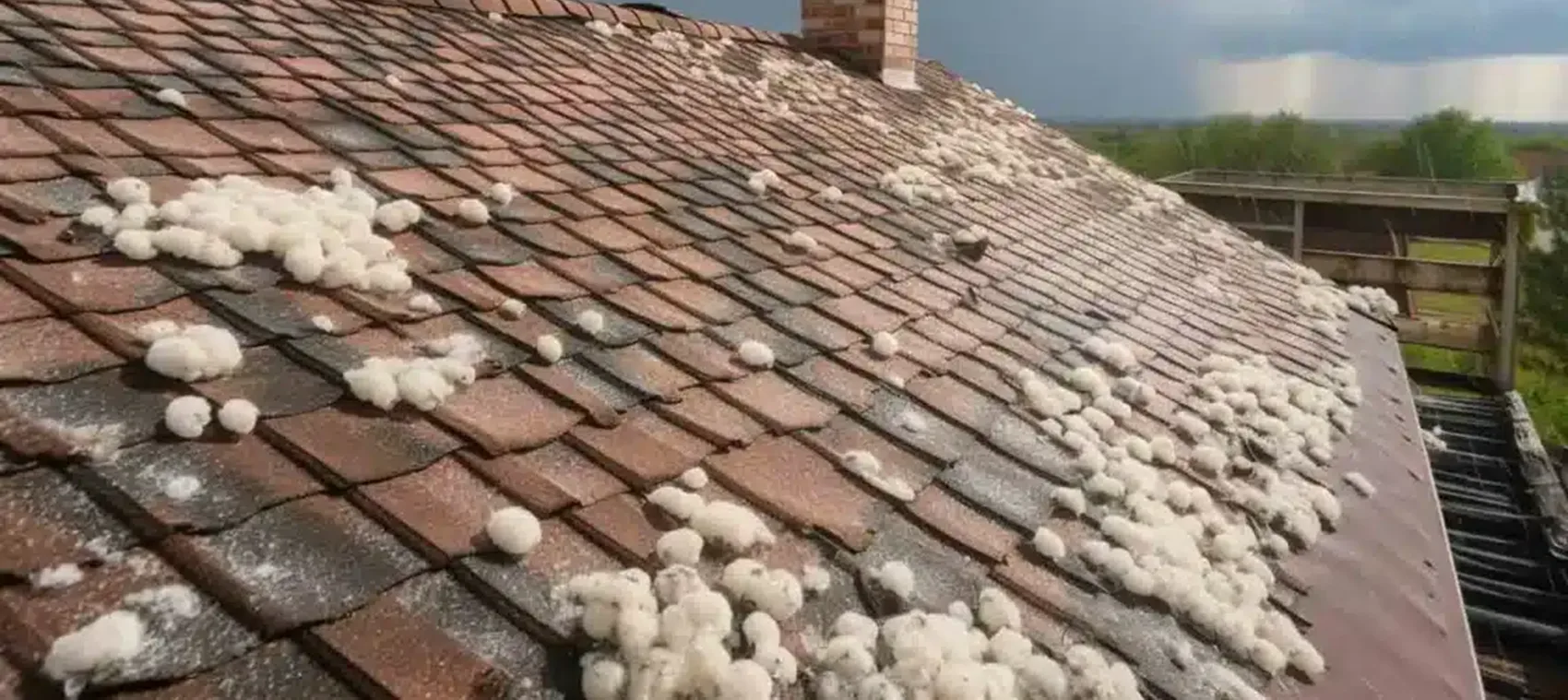
Most homeowners think about shingles, gutters, and flashing. Very few think about airflow. But what happens inside your attic affects everything above and below it. In a Texas climate — where summer attic temperatures can easily exceed 150°F — a poorly ventilated roof is not just uncomfortable. It is actively destroying your home from the inside. Heat bakes your shingles from underneath. Humidity breeds mold on your rafters. And your HVAC system works overtime trying to cool a house that is being heated from the top down.
The good news? A properly balanced ventilation system — with the right intake and exhaust setup — solves all of this. And it does not require major surgery on your roof. For our team, getting the ventilation right is one of the first things we assess on every job.
I’m Jason Roberts, owner of 12 Stones Roofing & Construction, a Service-Disabled Veteran-Owned firm based in Pasadena, Texas — with over a decade of hands-on experience diagnosing and correcting residential roof ventilation problems across the Gulf Coast region. Whether it is a new installation or a failing older system, understanding how air moves through your roof is something I deal with on every single project.
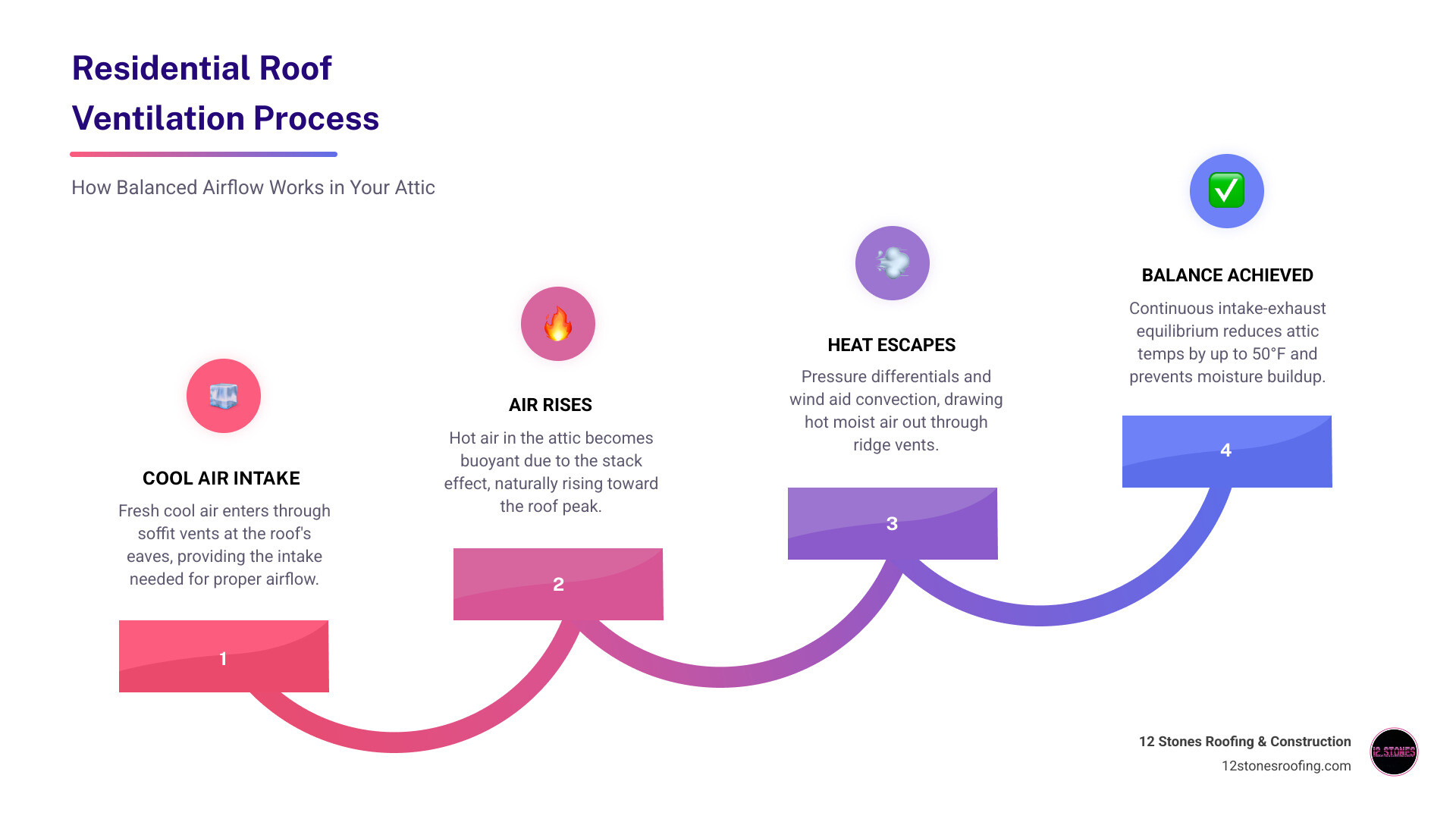
A properly designed residential roof ventilation system is the most effective way to protect your home from the brutal Texas heat, potentially reducing attic temperatures by up to 50°F. Proper airflow prevents the “oven effect” that bakes shingles from the inside out and traps corrosive moisture during humid months. By adhering to the 1/300 rule and ensuring unobstructed Net Free Area (NFA), you can extend the life of your roof while significantly lowering monthly cooling costs.
The Science of Residential Roof Ventilation: How It Works
To understand why your roof needs to “breathe,” we have to look at the physics of air. In a sealed attic, air becomes stagnant. During a Pasadena summer, the sun beats down on your shingles, transferring radiant heat into the attic space. Without a way for that heat to escape, your attic becomes a pressurized heat box.
The Physics of Air Movement
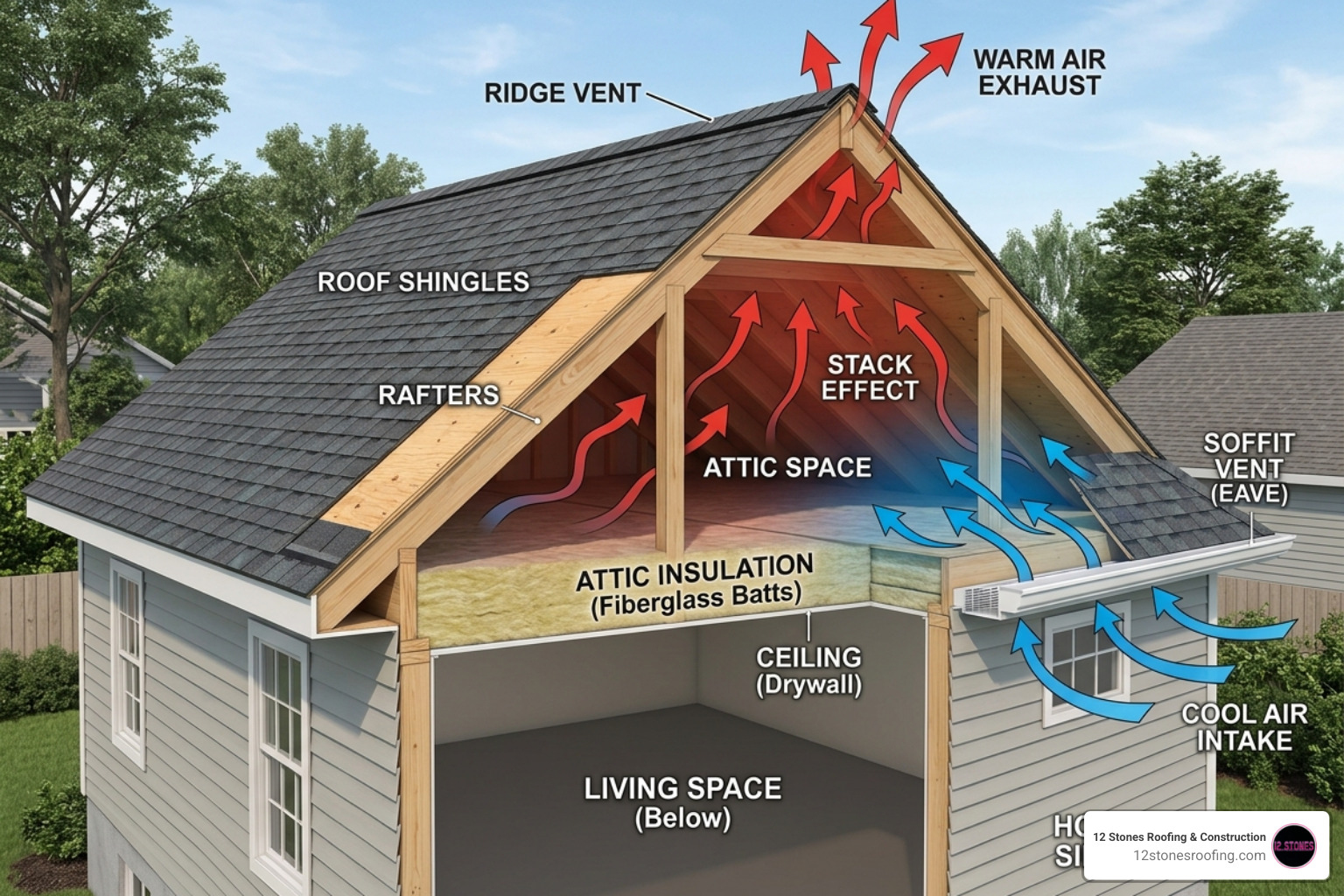
Proper residential roof ventilation relies on two primary natural forces: the stack effect and the wind effect.
- The Stack Effect (Thermal Buoyancy): This occurs because hot air is less dense than cold air. As the air in your attic heats up, it naturally rises. If there are exhaust vents at the highest point of your roof (the ridge), this hot air escapes. As it leaves, it creates a low-pressure area that pulls cooler air in through intake vents located at the lowest points (the soffits).
- The Wind Effect: When wind blows against your roof, it creates high pressure on the windward side and low pressure on the leeward side. This pressure difference naturally pushes air into intake vents and sucks it out of exhaust vents.
By utilizing Roof Ventilation Fundamentals, we design systems that work 24/7 without needing a single drop of electricity. This natural convection is especially important for different roof slope types, as steeper roofs have a larger volume of air that requires more aggressive movement to stay cool.
Why Balance is Non-Negotiable
The “Golden Rule” of roofing is balance. You want a 50/50 split between intake and exhaust. If you have too much exhaust and not enough intake, your roof will experience a vacuum effect. Instead of pulling fresh air from the outside, the system might start pulling air-conditioned air from your living room through recessed lights or attic hatches.
Conversely, having too much intake is generally safer than having too much exhaust, but an imbalanced system often leads to short-circuiting. This is when air travels between two exhaust vents rather than flowing from the bottom of the roof to the top, leaving “dead zones” of stagnant, hot air in the corners of your attic.
Essential Hardware for Residential Roof Ventilation
Choosing the right hardware is about more than just aesthetics; it is about “Net Free Area” (NFA). NFA is the actual amount of open space in a vent that allows air to pass through, excluding the mesh, louvers, or frames.
Choosing the Right Residential Roof Ventilation Hardware
At 12 Stones Roofing & Construction, we look for high-performance products that can withstand the humidity of La Porte and Pasadena.
- Ridge Vents: These are installed along the peak of the roof. Products like the GAF Cobra Rigid Vent 3 provide a low-profile look while offering significant NFA.
- Soffit Vents: Located under the eaves, these are your primary intake source. They can be continuous strips or individual perforated panels.
- Static Louvers (Box Vents): These are often used on roofs where a continuous ridge isn’t available. A Master Flow 60 sq. in. NFA Aluminum Slant Back Louver is a common, reliable choice.
- Turbine Vents: These “whirlybirds” use the wind to spin a fan that pulls air out. They are effective but require at least a 5 mph breeze to function optimally.
| Feature | Passive Ventilation (Ridge/Soffit) | Powered Ventilation (Electric/Solar) |
|---|---|---|
| Energy Cost | $0 (Natural) | Varies (Electric) or $0 (Solar) |
| Noise Level | Silent | Can have motor hum |
| Reliability | No moving parts to break | Motors can fail over time |
| Effectiveness | Constant, uniform airflow | High volume, but can be localized |
Intake vs. Exhaust Solutions
For homes without traditional eaves or soffits, we utilize drip edge vents or over-fascia vents. These allow air to enter at the gutter line. For exhaust, if a ridge vent isn’t feasible due to the roof’s shape, we might install off-ridge exhaust vents or hip vents to ensure no part of the attic remains unventilated.
Calculating Residential Roof Ventilation Requirements
You don’t need to be a mathematician to figure out your needs, but you do need to follow the International Residential Code (IRC).
The 1/300 Rule Explained
The standard requirement is the 1/150 rule: 1 square foot of NFA for every 150 square feet of attic floor space. However, if your system is “balanced” (meaning 40% to 50% of the vents are in the upper portion of the roof) and you have a vapor retarder, you can use the 1/300 rule.
For a 1,500-square-foot attic in Pasadena, the 1/300 rule looks like this:
- Total NFA Needed: 1,500 / 300 = 5 square feet.
- Convert to Inches: 5 x 144 = 720 square inches.
- Balance It: 360 sq. in. for intake and 360 sq. in. for exhaust.
If you aren’t sure if your home meets these standards, it is best to schedule a professional roof inspection to get an accurate measurement.
Adjusting for Roof Pitch and Volume
The steeper the roof, the more air volume is trapped inside. Industry experts suggest increasing your ventilation by 20% for pitches between 7:12 and 10:12, and by 30% for anything steeper than 11:12. More air space requires more “flushing” to keep temperatures stable.
Warning Signs of Poor Attic Airflow
How do you know if your residential roof ventilation is failing? Often, the signs are hidden until they become expensive problems.
Physical Indicators on the Roof
- Shingle Curling and Brittle Textures: If your shingles look like they are “frying,” it’s because they are. Excessive attic heat cooks the asphalt, leading to premature granule loss and cracking.
- Rusting Flashings: Trapped moisture in the attic will condense on metal surfaces like nails and vents, causing them to rust from the inside out.
- Ice Dams: While rare in the Houston area, during our occasional freezes, poor ventilation allows heat to escape unevenly, melting snow that then refreezes at the cold eaves, backing up under your shingles.
Interior Red Flags
If your ceilings feel warm to the touch on a summer evening, your attic is acting like a radiator. You might also notice musty odors or see “daylight” in the attic where you shouldn’t—or worse, no daylight at all because your vents are painted shut or blocked. If you see these signs, you should immediately request a roof repair assessment.
Common Installation Mistakes to Avoid
Even the best vents won’t work if they are installed incorrectly. We see these three mistakes more than anything else in the La Porte and Pasadena areas.
Blocked Soffit Vents
This is the #1 killer of roof systems. Homeowners or inexperienced contractors often blow insulation right over the soffit vents. Without intake air, the exhaust vents can’t do their job. We use insulation baffles (also called rafter vents) to create a clear channel for air to flow from the soffit up into the attic.
The Danger of Mixing Vent Types
Never mix different types of exhaust vents on the same roof line. For example, do not use a power fan in conjunction with a ridge vent. The power fan will pull air from the ridge vent (the path of least resistance) instead of pulling it from the soffits. This “short-circuits” the system, leaving the lower half of your roof completely unventilated.
Improper Underlayment Cuts
Believe it or not, we often find ridge vents installed where the roofer forgot to actually cut the slot in the roof deck or underlayment. The vent looks great from the street, but it is doing absolutely nothing for the house.
Frequently Asked Questions about Attic Airflow
How much ventilation does my attic actually need?
The International Residential Code (IRC) generally requires 1 square foot of ventilation for every 300 square feet of attic floor space, provided the system is balanced between intake and exhaust. If the system is not balanced, the requirement increases to 1 square foot per 150 square feet of attic space.
Can a roof have too much ventilation?
While rare, an excessive number of exhaust vents without sufficient intake can create a vacuum that pulls conditioned air from the living space or leads to rain and snow ingestion. However, having “too much” intake is rarely a problem; in fact, a slight excess of intake can help pressurize the attic and keep weather out.
Do solar attic fans work better than ridge vents?
Solar fans provide active airflow without electricity costs, but they are often less effective than a continuous, balanced ridge-and-soffit system. Ridge vents work 24/7 via natural convection and have no moving parts to fail. Solar fans only work when the sun is out, which may not be enough to handle moisture removal on humid, cloudy days.
Conclusion
Optimizing your attic airflow is a high-ROI investment that protects your home’s structural integrity and your family’s comfort. Whether you are dealing with the humidity of the Gulf Coast or the intense Texas sun, a balanced system is your roof’s best defense. At 12 Stones Roofing & Construction, we don’t just look at the shingles; we look at the entire roofing system to ensure your home stays dry, cool, and efficient. For a comprehensive assessment of your home’s needs, contact the experts at 12 Stones Roofing & Construction today to ensure your ventilation system meets the highest industry standards. We serve our neighbors in Pasadena, La Porte, and the surrounding communities with the transparency and local expertise you deserve.