
What Does TPO Roofing Cost in 2026? (Quick Answer)
TPO roofing cost in 2026 runs between $5.50 and $10.30 per square foot fully installed for most commercial projects. If you need a number fast, here it is:
| Project Type | Cost Per Sq Ft | Typical Total |
|---|---|---|
| Basic (45-mil, mechanically attached) | $5.50 – $7.00 | Varies by size |
| Standard (60-mil, fully adhered) | $6.50 – $8.50 | Varies by size |
| Premium (80-mil, with tear-off) | $8.00 – $10.30 | Varies by size |
| Average 1,500 sq ft project | $4.50 – $16.00 | ~$10,700 |
These are planning numbers. Your actual cost depends on roof size, membrane thickness, attachment method, insulation, and whether tear-off is required.
If your Pasadena or Gulf Coast property has an aging flat roof — or you just took storm damage — getting a clear cost picture before you call a contractor is smart. TPO has become the most widely specified commercial flat roof membrane in the United States, making up roughly 40% of the commercial roofing market. And for good reason: it reflects up to 80% of solar radiation, it’s cost-effective, and it performs well in Texas heat.
But pricing can be confusing. Online estimates range from $4 to $16 per square foot, and that wide spread isn’t random. It reflects real differences in materials, labor, insulation, and site conditions. As a trusted commercial roofing contractor serving the Gulf Coast, 12 Stones Roofing & Construction sees this confusion regularly — and this guide cuts through it.
I’m Jason Roberts, owner of 12 Stones Roofing & Construction, a Service-Disabled Veteran-Owned firm based in Pasadena, Texas, with over a decade of hands-on experience installing and pricing TPO roofing systems across the Gulf Coast region. Understanding TPO roofing cost from the inside out — materials, labor, insulation, wind zone requirements — is core to what we do every day.
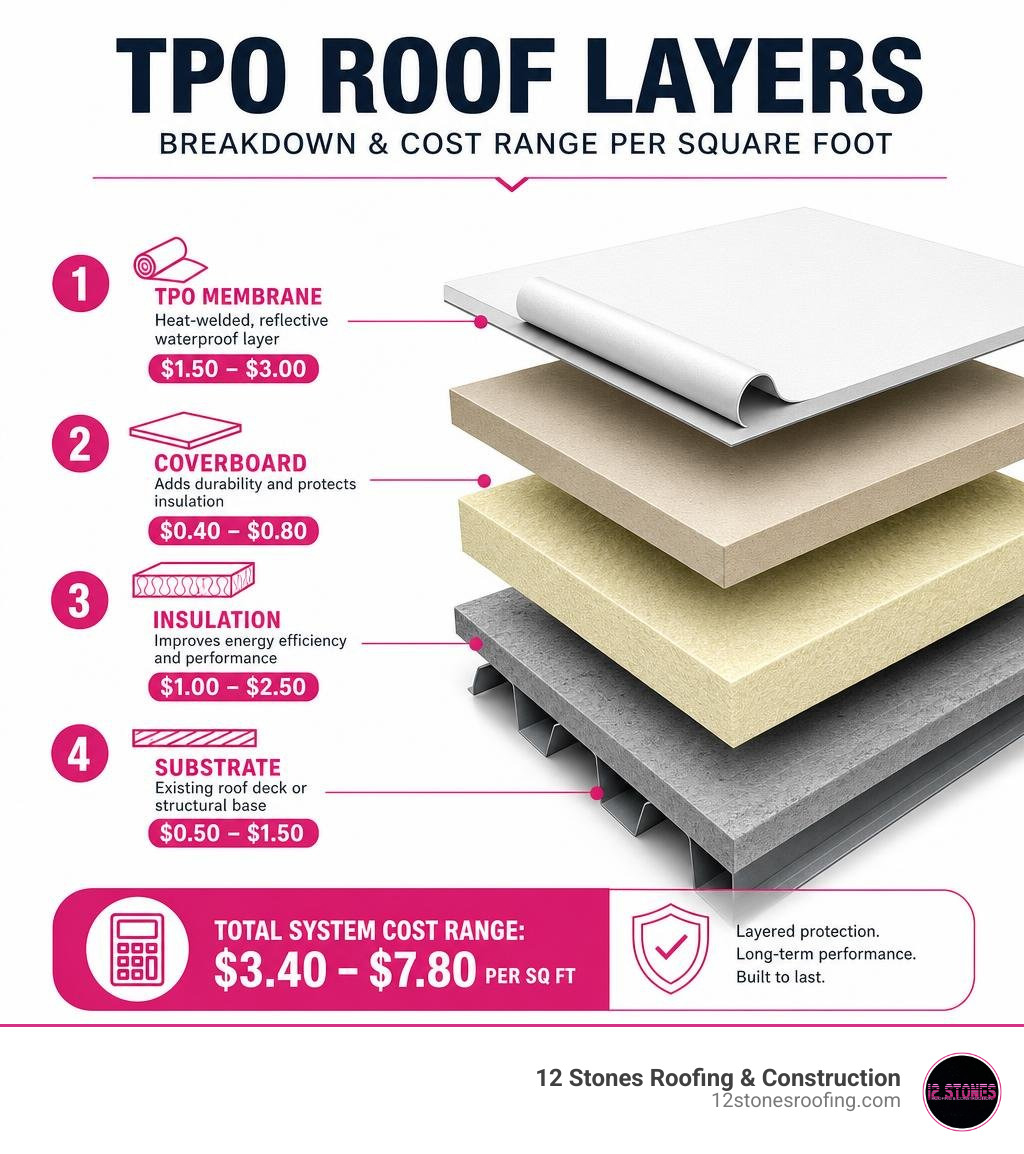
TPO roofing cost terms you need:
Average TPO Roofing Cost Per Square Foot in 2026
In 2026, the national average cost to install a TPO roof ranges from $5.50 to $10.30 per square foot fully installed. For standard commercial low-slope installations, a realistic planning baseline is $8.04 to $10.29 per square foot, which includes standard insulation, mechanical attachment, and basic perimeter flashing.
These numbers reflect the current state of the supply chain and commercial labor markets as of June 2026. While raw materials make up a substantial portion of your estimate, local labor rates, safety requirements, and site complexity dictate where your project falls within this range. To track macro-level industry pricing and material shifts, you can consult neutral industry publications like Roofing Contractor Magazine.
What is the average TPO roofing cost for commercial buildings?
Fully installed commercial TPO roofing systems typically range from $4.50 to $16.00 per square foot depending on scale and design requirements. For a standard 1,500-square-foot light commercial space or a small low-slope facility, the average total cost is approximately $10,700, with most typical projects landing between $6,500 and $24,000.
Larger commercial properties benefit from economies of scale. As the total square footage increases, the setup and mobilization overhead costs are distributed over a wider area, bringing down the unit cost per square foot. However, if your building has multiple roof levels, poor access, or extensive HVAC equipment penetrations, those factors will push the price back toward the higher end of the spectrum. To understand how these variables interact, you can read our detailed breakdown on how to avoid overpaying in Don’t Get Roofed: Unpacking TPO Installation Costs.
TPO vs. PVC and EPDM: Commercial Membrane Cost Comparison
TPO remains the most cost-effective reflective single-ply membrane available on the market today. Raw TPO membrane material costs average $0.50 per square foot, compared to $0.55 per square foot for EPDM and $0.77 per square foot for PVC.
| Membrane Type | Raw Material Cost (per sq. ft.) | Fully Installed Cost (per sq. ft.) | Average Lifespan | Key Characteristics |
|---|---|---|---|---|
| TPO (Thermoplastic Polyolefin) | $0.50 | $5.50 – $10.30 | 15 – 30 Years (Avg. 22) | Highly reflective, heat-welded seams, cost-effective |
| EPDM (Rubber) | $0.55 | $5.00 – $8.00 | 20 – 30 Years | Lower reflectivity, glued seams, durable in cold climates |
| PVC (Polyvinyl Chloride) | $0.77 | $7.00 – $12.00 | 20 – 30 Years | Chemical/grease resistant, flexible, premium price point |
While EPDM can sometimes cost slightly less at the absolute low end of basic installations, it lacks the natural solar reflectivity of white TPO. On the other hand, PVC offers excellent resistance to animal fats and chemical exhaust, making it ideal for restaurants, but it carries a significant cost premium. For most standard commercial warehouses, retail spaces, and offices in hot climates like Pasadena and La Porte, white TPO provides the optimal balance of upfront cost and long-term thermal efficiency. You can explore the cooling benefits of highly reflective single-ply options in our White TPO Roofing Guide 2025.
Key Cost Components of a TPO Roof Installation
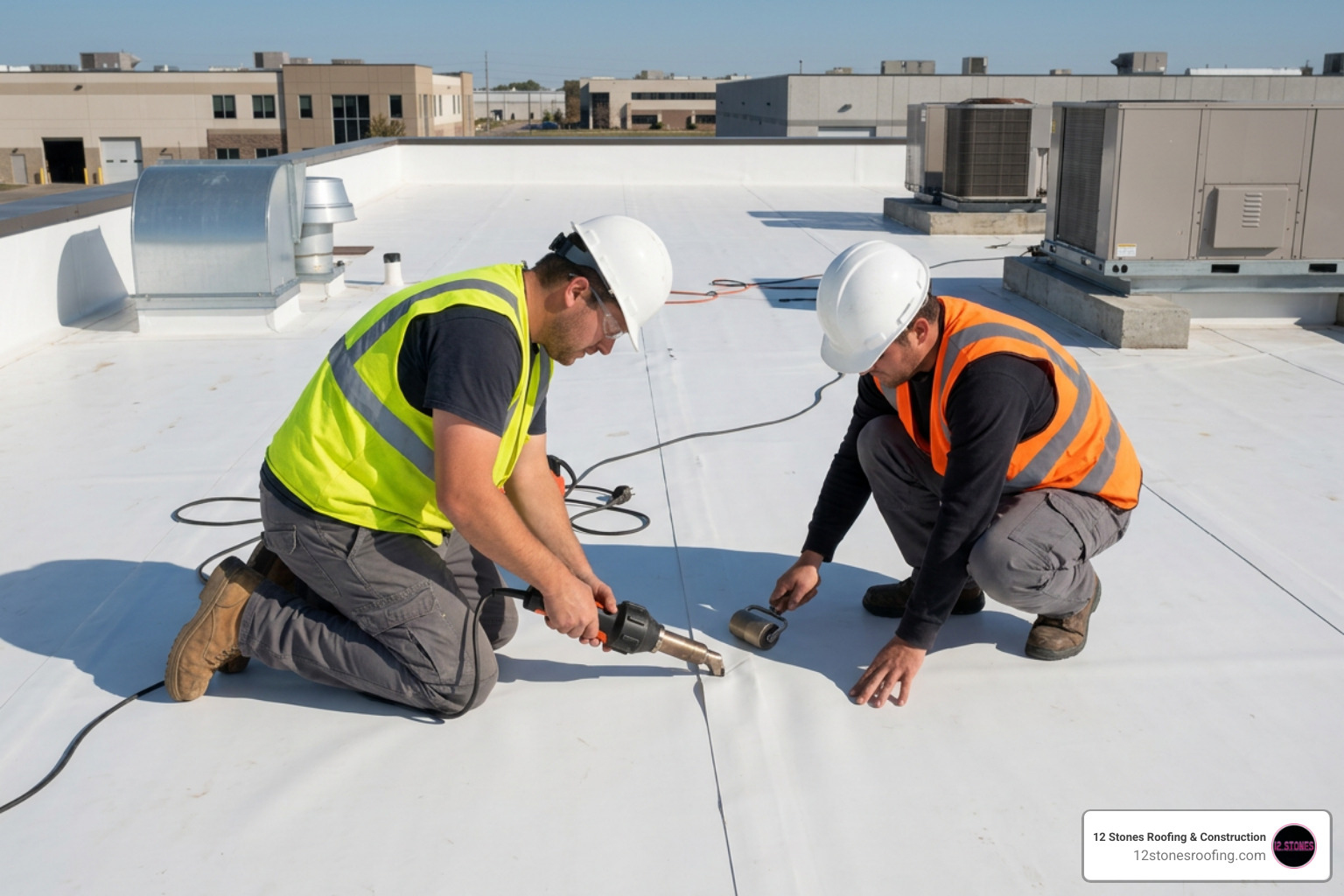
A standard TPO installation budget is split roughly 40% for materials and accessories and 60% for labor, equipment, and contractor overhead.
Because a commercial roof is a highly engineered assembly rather than a single layer of plastic, every component plays a role in the final price. To run a preliminary estimate based on your building’s specific footprint and parameters, you can use the interactive TPO Roofing Cost Calculator | Free Online Calculator.
Membrane Materials and Accessories
The TPO membrane itself is sold in rolls, typically ranging in width from 5 to 12 feet and lengths of 50 to 100 feet. Material-only costs for the membrane range from $0.70 to $1.50 per square foot depending on the thickness.
However, the membrane is only one part of the material package. A secure, watertight system requires specialized accessories:
- Flashing and Edge Details: Metal drip edges, coping caps, and wall flashing cost between $5 and $50 per linear foot.
- Prefabricated Accessories: TPO pipe boots, inside/outside corners, and expansion joint covers speed up installation but add to the material bill.
- Adhesives and Fasteners: Heavy-duty bonding adhesives, plates, and screws secure the system against high wind uplift forces.
To learn more about the specific rolls, reinforcement styles, and accessory options available, read our AZ Guide to TPO Single Ply Membrane Options.
Labor and Installation Rates
Labor rates for professional TPO installation range from $3.00 to $7.00 per square foot, which translates to hourly crew rates of $75 to $120 per hour.
Labor is heavily influenced by the complexity of your roof. A wide-open, rectangular warehouse roof with zero penetrations can be installed rapidly, keeping labor costs near the lower end. Conversely, a roof with numerous penetrations — such as 30 HVAC curbs, skylights, plumbing vents, and complex parapet walls — requires extensive hand-welding and custom flashing detail. This level of detail can increase labor costs by 30% to 50% due to the meticulous detail work required to guarantee a leak-free seal.
Insulation and Substrate Preparation
Insulation represents up to 30% of the total project cost on a full TPO replacement. It is a critical component because TPO membranes have an insulation value of R-0; all thermal resistance must come from the underlying substrate.
The three most common commercial insulation types include:
- Polyisocyanurate (PolyISO): The industry standard for flat roofs, offering the highest R-value per inch. It costs between $1.60 and $2.40 per square foot.
- Expanded Polystyrene (EPS): A highly cost-effective option that costs $3.00 to $4.20 per square foot for thicker profiles, though it offers slightly lower R-value per inch than PolyISO.
- Extruded Polystyrene (XPS): Falling between the two in performance, XPS costs $1.60 to $2.00 per square foot and is highly resistant to moisture absorption.
How Membrane Thickness and Attachment Methods Impact Pricing
Your choice of membrane thickness and how that membrane is anchored to the deck will directly dictate your system’s wind uplift rating, puncture resistance, and long-term warranty options.
How does membrane thickness affect TPO roofing cost?
Thicker TPO membranes offer superior puncture resistance, enhanced UV stability, and longer manufacturer warranties, but they increase material costs by 20% to 40%.
- 45-Mil TPO ($5.00 – $7.00 per sq. ft. installed): The budget-friendly option. It is typically specified for short-term commercial leases or buildings with zero foot traffic. It generally carries a 15-year manufacturer warranty.
- 60-Mil TPO ($6.00 – $8.50 per sq. ft. installed): The industry standard. It represents the best balance of cost, puncture resistance, and longevity. It easily qualifies for a 20-year NDL (No Dollar Limit) warranty.
- 80-Mil TPO ($7.50 – $9.50 per sq. ft. installed): The premium specification. It is designed for high-traffic roofs that experience frequent HVAC servicing or hail exposure. It qualifies for robust 25- to 30-year warranties.
While choosing a 45-mil membrane saves money upfront, the minor savings rarely justify the reduced service life and vulnerability to punctures. For a deeper look at how membrane degradation and punctures occur over time, check out our guide on Uncovering the Most Common TPO Roof Membrane Problems.
Mechanically Attached vs. Fully Adhered vs. Ballasted Systems
The attachment method you select changes both the labor speed and the material quantities required for your project.
- Mechanically Fastened ($2.00 – $3.00 per sq. ft. labor cost): The fastest and most common installation method. The membrane is fastened directly to the deck using heavy-duty screws and plates through the seams, which are then heat-welded shut.
- Fully Adhered ($2.75 – $3.50 per sq. ft. labor cost): The membrane is glued down to the substrate using special bonding adhesive. This creates a smooth, flat appearance and eliminates membrane fluttering. It is highly recommended for coastal wind zones.
- Ballasted Systems ($1.50 – $2.50 per sq. ft. labor cost): The membrane is laid loose over the substrate and held in place by heavy river rock or concrete pavers. While inexpensive to install, ballasted systems are rarely used in our local Texas coastal markets due to structural weight limits and windborne debris hazards during hurricanes.
For properties in Pasadena, La Porte, and the surrounding Gulf Coast areas, meeting wind uplift codes is non-negotiable. In high-wind zones, mechanically attached systems require significantly increased fastener density in the perimeter and corner zones (adding $0.30 to $0.60 per square foot to those areas). Fully adhered systems provide the highest wind resistance and are often the preferred choice to meet local building codes.
TPO Cost Breakdown by Building Size and Location
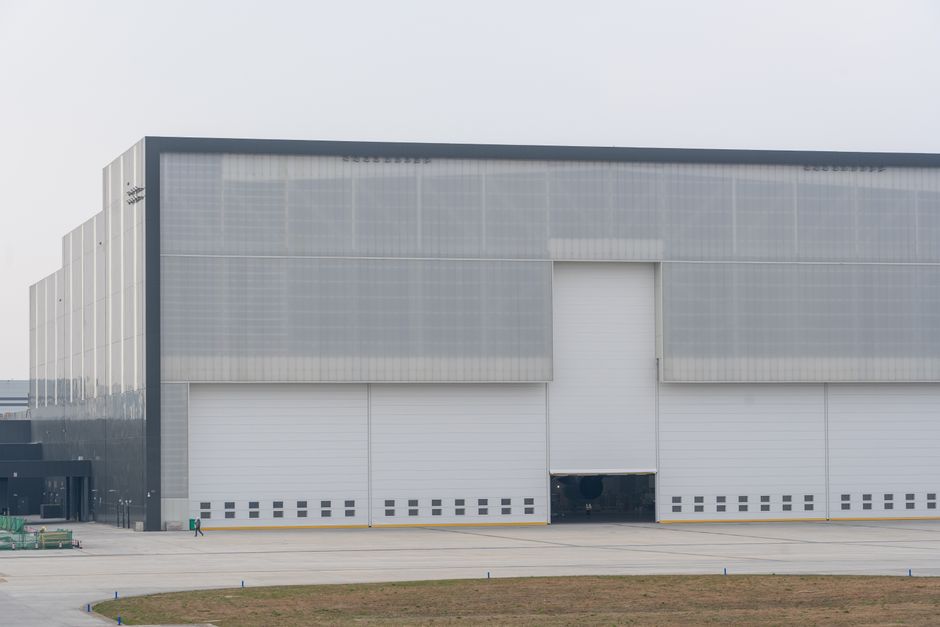
When budgeting for a commercial TPO installation, the total footprint of your building plays a massive role in the final price per square foot.
Estimated Cost by Square Footage (10k, 25k, 50k SQ FT)
To illustrate how scale affects commercial pricing, here is a breakdown of estimated total costs for three common building sizes using standard 60-mil TPO with code-compliant PolyISO insulation:
- 10,000 Sq. Ft. Roof (e.g., a local retail center or office clinic): Expect a total cost of $80,400 to $102,900. The unit cost remains closer to the national average because mobilization, safety setup, and edge details represent a larger share of the overall project.
- 25,000 Sq. Ft. Roof (e.g., a medium warehouse or school facility): Expect a total cost of $201,000 to $257,250. Increased purchasing power on materials and efficient labor production begin to lower the average cost per square foot.
- 50,000 Sq. Ft. Roof (e.g., a large industrial facility or distribution center): Expect a total cost of $402,000 to $514,500. At this scale, installation crews can establish highly efficient production lines, significantly reducing the per-square labor cost.
Regional Price Variations: Texas vs. High-Cost Areas
Regional labor markets, local climate conditions, and energy codes create massive regional price differences.
In Texas, basic statewide TPO installations range from $4.00 to $7.50 per square foot, with premium, high-wind-rated systems running $6.00 to $10.00 per square foot. Texas pricing is often lower than the national average due to competitive local labor rates and straightforward access on most commercial properties.
By comparison, high-cost regions like Los Angeles or San Francisco, California, see average TPO costs of $8.00 to $12.50+ per square foot. These elevated prices are driven by higher local labor rates, strict OSHA compliance, and rigid Title 24 cool roof regulations that require thick, high-R-value insulation assemblies.
If you are looking for local expertise near our primary service areas, you can connect with our experienced team of commercial roofers in Houston, TX to get a precise, site-specific estimate. For a complete look at how we design flat roof systems for local businesses, browse our TPO Roofing Complete Guide.
Frequently Asked Questions About Flat Roof Replacements
Is TPO roofing worth the investment?
Yes, TPO roofing is highly worth the investment for low-slope and flat commercial structures. It offers an expected lifespan of 15 to 30 years and can lower a building’s cooling costs by 20% to 30% due to its highly reflective white surface. This reflectivity reduces the load on commercial HVAC systems during hot Texas summers, allowing the roof to pay for itself over time through energy savings.
Can TPO be installed over an existing roof?
Yes, TPO can be installed over an existing roof membrane (known as a recover or overlay), provided local building codes allow it and the existing substrate is dry and structurally sound. A recover installation saves $1.50 to $3.00 per square foot by eliminating the labor and disposal fees associated with a full tear-off. However, building codes limit commercial roofs to a maximum of two layers, and we always recommend performing an infrared moisture scan first to ensure you aren’t trapping wet insulation beneath the new membrane.
How long does a TPO roof last?
A professionally installed TPO roof lasts an average of 22 years, with a typical range of 15 to 30 years. You can maximize your roof’s lifespan by scheduling semi-annual inspections (typically in spring and fall), keeping commercial drains clear of debris, and patching minor physical punctures immediately before moisture can migrate into the insulation boards.
Conclusion
Calculating your TPO roofing cost is about more than just picking a membrane off a shelf. From the thickness of your TPO sheet (with 60-mil serving as the reliable industry standard) to the type of insulation and the wind uplift requirements of the Texas Gulf Coast, every decision impacts both your upfront budget and your long-term return on investment.
Working with a local, licensed commercial contractor who understands Pasadena and La Porte building codes is the best way to avoid underbidding surprises or costly overpayments.
Ready to get a precise, transparent, and itemized quote for your commercial property? Contact the experts at 12 Stones Roofing & Construction today to schedule your professional on-site evaluation.
- Explore Our Services: Learn more about our specialized TPO Roofing Services and how we protect your business from the elements.