
Why Understanding TPO Roof Installation Cost Matters for Your Commercial Property
TPO roof installation cost typically ranges from $5.50 to $10.30 per square foot, with most commercial projects averaging $11,200 nationally. Your actual cost depends on roof size, membrane thickness, installation method, and local labor rates.
Quick TPO Cost Breakdown:
| Roof Size | Cost Range | Average Total |
|---|---|---|
| 500 sq ft | $2,750 – $5,150 | $3,950 |
| 1,000 sq ft | $5,500 – $10,300 | $7,900 |
| 2,000 sq ft | $11,000 – $20,600 | $15,800 |
| 5,000 sq ft | $27,500 – $51,500 | $39,500 |
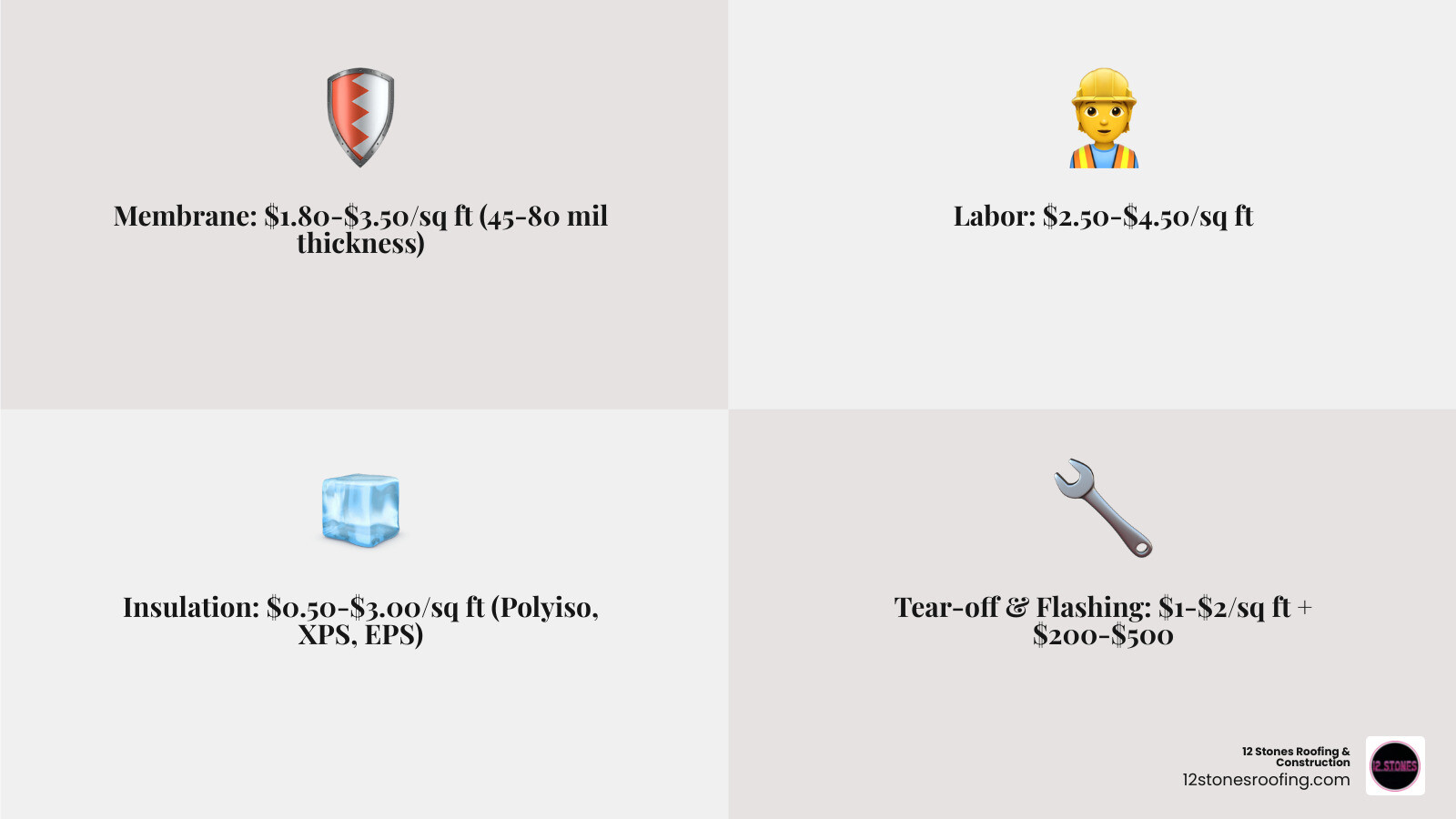
Material costs: $1.80 – $3.50 per sq ft
Labor costs: $2.50 – $4.50 per sq ft
Additional factors: Insulation ($0.50 – $3.00 per sq ft), tear-off ($1 – $2 per sq ft), flashing ($200 – $500)
If you’re a commercial property owner in Pasadena or the Houston area, you’ve probably noticed more white roofs on warehouses, retail centers, and office buildings. That’s TPO roofing taking over the flat roof market.
TPO stands for Thermoplastic Polyolefin. It’s a single-ply white membrane that reflects heat, resists UV damage, and holds up against Texas weather. It’s become the go-to choice for flat and low-slope commercial roofs because it balances performance with affordability.
But “affordable” doesn’t mean cheap—and it definitely doesn’t mean simple.
The real question isn’t just “how much does TPO cost?” It’s “what am I actually paying for?”
Because TPO roof installation cost varies widely based on factors most property owners don’t think about until they’re comparing bids. Membrane thickness. Insulation type. Installation method. Roof access. Existing roof removal. All of these add up fast.
This guide breaks down every cost factor so you know what to expect, what to budget for, and what questions to ask before signing a contract. You’ll learn how to compare quotes accurately, avoid surprise charges, and make a smart investment in your building’s protection.
As Jason Roberts, owner of 12 Stones Roofing & Construction, I’ve overseen hundreds of TPO roofing installations across the Gulf Coast over the past decade, helping commercial clients steer TPO roof installation cost with full transparency and manufacturer-backed warranties. My team and I walk every property owner through the real numbers—no hidden fees, no upselling—so you can budget with confidence.
Easy TPO roof installation cost glossary:
What is TPO Roofing and Why is it the Standard for Flat Roofs?
Thermoplastic Polyolefin (TPO) is a single-ply roofing membrane that has rapidly become the gold standard for commercial properties in Pasadena, TX and La Porte, TX. But what makes it so special? It is essentially a blend of polypropylene and ethylene-propylene rubber, reinforced with a polyester scrim. This chemical makeup gives it the flexibility of rubber and the performance of hot-air-weldable plastic.
The primary reason we recommend TPO Roofing for our local business owners is its incredible resistance to UV rays and ozone. In the intense Texas heat, standard roofs can bake and crack. TPO, however, is naturally reflective. Its bright white surface can reflect up to 80% of the sun’s rays, which drastically lowers your cooling bills—a major factor in managing long-term building expenses.
Beyond energy efficiency, TPO is highly praised for its heat-welded seams. Unlike EPDM (rubber) roofs that rely on adhesives or tape which can degrade over time, TPO seams are fused together with hot air to form a permanent, waterproof bond. This is critical for preventing leaks in areas prone to heavy Gulf Coast rains. Proper installation ensures that your building adheres to the Moisture Control Guidance for Building Design provided by the EPA, keeping your interior dry and mold-free.
Breaking Down the TPO Roof Installation Cost by the Square Foot
When budgeting for a project, the most common question we hear is: “What is the price per square?” In roofing terminology, a “square” is 100 square feet. In 2025, the average TPO roof installation cost in our region ranges from $550 to $1,030 per square for a complete system including labor and materials.
The national average for a TPO installation sits around $11,200, but this figure can be misleading because commercial roofs vary wildly in size. A small retail storefront in Pasadena might cost $8,000, while a large warehouse in La Porte could easily exceed $100,000.
Here is a more detailed look at how costs scale with roof size:
| Total Square Footage | Estimated Cost Range | Common Building Type |
|---|---|---|
| 1,000 sq ft | $5,500 – $10,300 | Small Office/Garage |
| 5,000 sq ft | $27,500 – $51,500 | Retail Strip Center |
| 10,000 sq ft | $55,000 – $103,000 | Mid-sized Warehouse |
| 20,000 sq ft | $110,000 – $206,000 | Industrial Facility |
It is important to note that smaller roofs often have a higher cost per square foot. This is because fixed costs—like mobilization, permits, and safety equipment—are spread over a smaller area. For more context on how these prices compare to other systems, check out our guide on Commercial Roof Installation Cost.
Labor is a significant portion of your bill, typically accounting for $2.50 to $4.50 per square foot. These rates are influenced by local economic trends, which you can track via the Occupational Employment and Wage Statistics. In the Houston metro area, skilled labor for heat-welding TPO is in high demand, which is why we focus on maintaining an expert, in-house crew rather than using uncertified subcontractors.
Key Factors That Influence Your TPO Roof Installation Cost
If you receive three different quotes for a TPO roof, they will likely vary by thousands of dollars. This isn’t usually a mistake; it’s because of the variables involved in the “roofing sandwich.”
Insulation: The Hidden Cost (and Benefit)
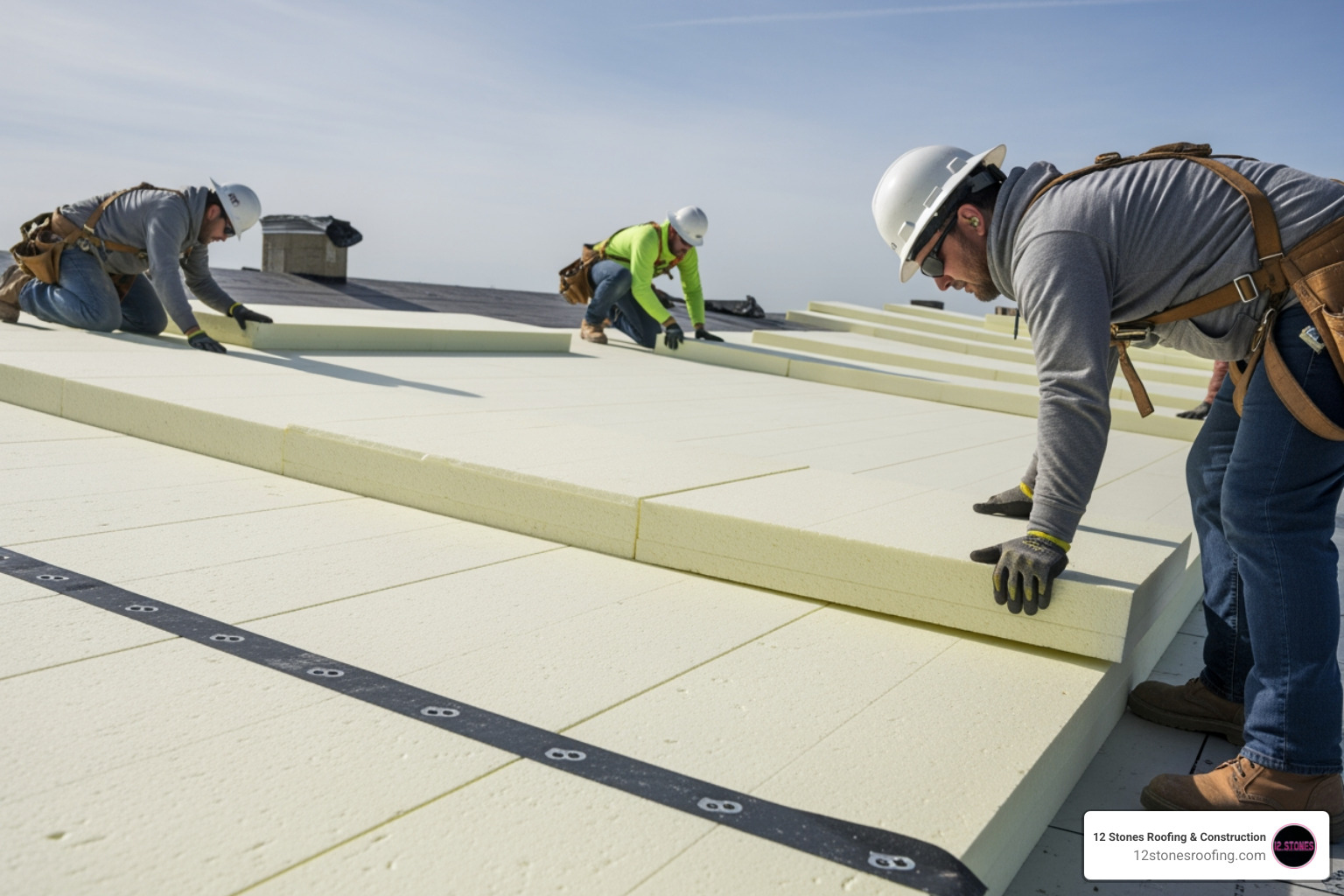
Insulation isn’t just for keeping the building warm; in Texas, it’s about keeping the heat out. Insulation typically accounts for about 25% of the total TPO roof installation cost. We use several types of boards depending on your budget and R-value needs:
- Polyisocyanurate (Polyiso): The industry favorite. It offers the highest R-value per inch but costs between $1.60 and $2.40 per square foot.
- Extruded Polystyrene (XPS): Great for moisture resistance, costing roughly $1.60 to $2.00 per square foot.
- Expanded Polystyrene (EPS): A more budget-friendly option, though it requires more thickness to achieve the same R-value.
Roof Complexity and Accessibility
A wide-open, flat warehouse roof is the easiest to install. However, if your roof has dozens of HVAC units, skylights, pipes, or multiple levels, the labor cost increases. Each “penetration” (anything that sticks out of the roof) requires custom flashing and detailed welding, which can add $200 to $500 per unit to your total.
Tear-Off and Disposal
Are we installing a new roof over your old one, or starting from scratch? A “recover” (overlay) is cheaper but only possible if you have one existing layer and the deck is dry. If we have to remove the old material, expect to add $1.00 to $2.00 per square foot for labor and dump fees. For a deeper dive into replacement logistics, see our Roof Replacement Cost Guide 2026.
How Membrane Thickness Impacts TPO Roof Installation Cost
TPO membranes are measured in “mils” (one-thousandth of an inch). The thickness you choose directly impacts the lifespan and the TPO roof installation cost.
- 45 Mil: The entry-level option. It is the thinnest and most affordable ($1.80 – $2.30/sq ft for material). It is suitable for buildings with very low foot traffic, but it is more prone to punctures and has a shorter lifespan (10–15 years).
- 60 Mil: The industry standard. It offers a great balance of durability and price ($2.00 – $3.10/sq ft for material). Most manufacturers require at least 60 mil to provide a 20-year warranty.
- 80 Mil: The “heavy-duty” choice. It is significantly thicker and more resistant to hail and punctures ($2.50 – $3.50/sq ft for material). We recommend this for roofs with frequent maintenance traffic or for owners who want a 25-30 year lifespan.
Technical specifications for these materials are often cited in the Product and Supplies Data: The HUD PATH Rehab Guide Volume 3: Roofs, which highlights the importance of thickness in long-term building rehabilitation.
Choosing the Right Method to Manage TPO Roof Installation Cost
How we attach the TPO to your building also changes the price tag. There are three main ways to get the job done:
- Mechanically Fastened ($2.00 – $3.10/sq ft installed): This is the most common and cost-effective method. We use heavy-duty screws and plates to secure the membrane to the roof deck. It’s fast and reliable for most standard buildings.
- Fully Adhered ($2.80 – $3.50/sq ft installed): The membrane is glued to the insulation or substrate using a special adhesive. This is the “premium” method. It provides the best wind uplift resistance (perfect for hurricane-prone areas like Pasadena) and looks the smoothest.
- Ballasted ($1.80 – $2.50/sq ft installed): The membrane is laid down loosely and held in place by large stones or pavers. While cheap, it adds immense weight to the building and makes finding leaks very difficult. We rarely recommend this for modern Texas commercial buildings.
Selecting the right method is a major part of any Roof Installation Cost Guide, as it dictates both the upfront price and the wind-speed rating of your warranty.
Comparing TPO to EPDM and PVC: Performance vs. Price
When you’re looking at flat roofing, you’ll likely hear about EPDM (rubber) and PVC. Here is how TPO stacks up against them in terms of value:
| Feature | TPO | EPDM | PVC |
|---|---|---|---|
| Average Cost | $5.50 – $10.30/sq ft | $4.00 – $11.00/sq ft | $8.00 – $14.00/sq ft |
| Seam Strength | Heat-Welded (Strongest) | Tape/Adhesive (Weaker) | Heat-Welded (Strongest) |
| Reflectivity | High (White) | Low (Black) | High (White) |
| Chemical Resistance | Moderate | Low | High |
| Lifespan | 15 – 30 Years | 20 – 30 Years | 20 – 30 Years |
TPO vs. EPDM: EPDM is often slightly cheaper upfront, but because it is black, it absorbs heat. In Pasadena, this can cause your A/C units to work overtime. EPDM seams are also a common failure point. TPO’s welded seams and white surface generally offer a better Return on Investment (ROI) in our climate.
TPO vs. PVC: PVC is the “luxury” version of TPO. It is more resistant to chemicals and grease (making it ideal for restaurants), but it can cost 20-40% more. For most warehouses and office buildings, TPO provides 90% of the benefits of PVC at a much lower TPO roof installation cost.
For a more comprehensive look at these materials, visit our New Flat Roof Installation Guide.
Conclusion: Securing Your Investment with Professional Installation
A TPO roof is a significant investment in your business’s future. While the TPO roof installation cost might seem daunting at first, the energy savings and leak protection it provides often pay for the system over its lifespan.
However, the best material in the world will fail if it’s installed incorrectly. Poorly welded seams are the #1 cause of TPO failure. That’s why choosing an experienced local contractor is vital. At 12 Stones Roofing & Construction, we don’t just “slap on a membrane.” We perform a comprehensive final inspection to ensure every weld is air-tight and every flashing is secure.
We serve the Pasadena, TX and La Porte, TX communities with transparent pricing and a commitment to protecting your property against the toughest Texas storms. Whether you need a small repair or a 50,000-square-foot replacement, our team is ready to help.
Ready for an accurate quote? Don’t guess your costs—get them from a pro.
Call us today at 713-715-7663 or visit our TPO Roofing page to schedule your free commercial roof assessment.