
What Is Black TPO Roofing — And Is It Right for Your Commercial Building?
Black TPO roofing is a single-ply thermoplastic polyolefin membrane available in a dark colorway, offering the same heat-welded seam strength and chemical resistance as standard white TPO — but with higher heat absorption that benefits cold-climate buildings and delivers a sleek, modern aesthetic for commercial properties. As a leading provider of expert commercial roofing services in Pasadena, 12 Stones Roofing & Construction helps property owners navigate these specialized material choices. Whether you are looking for professional roofers in Houston or specialized industrial solutions, understanding the thermal dynamics of your roof is essential for long-term ROI.
Here’s what you need to know at a glance:
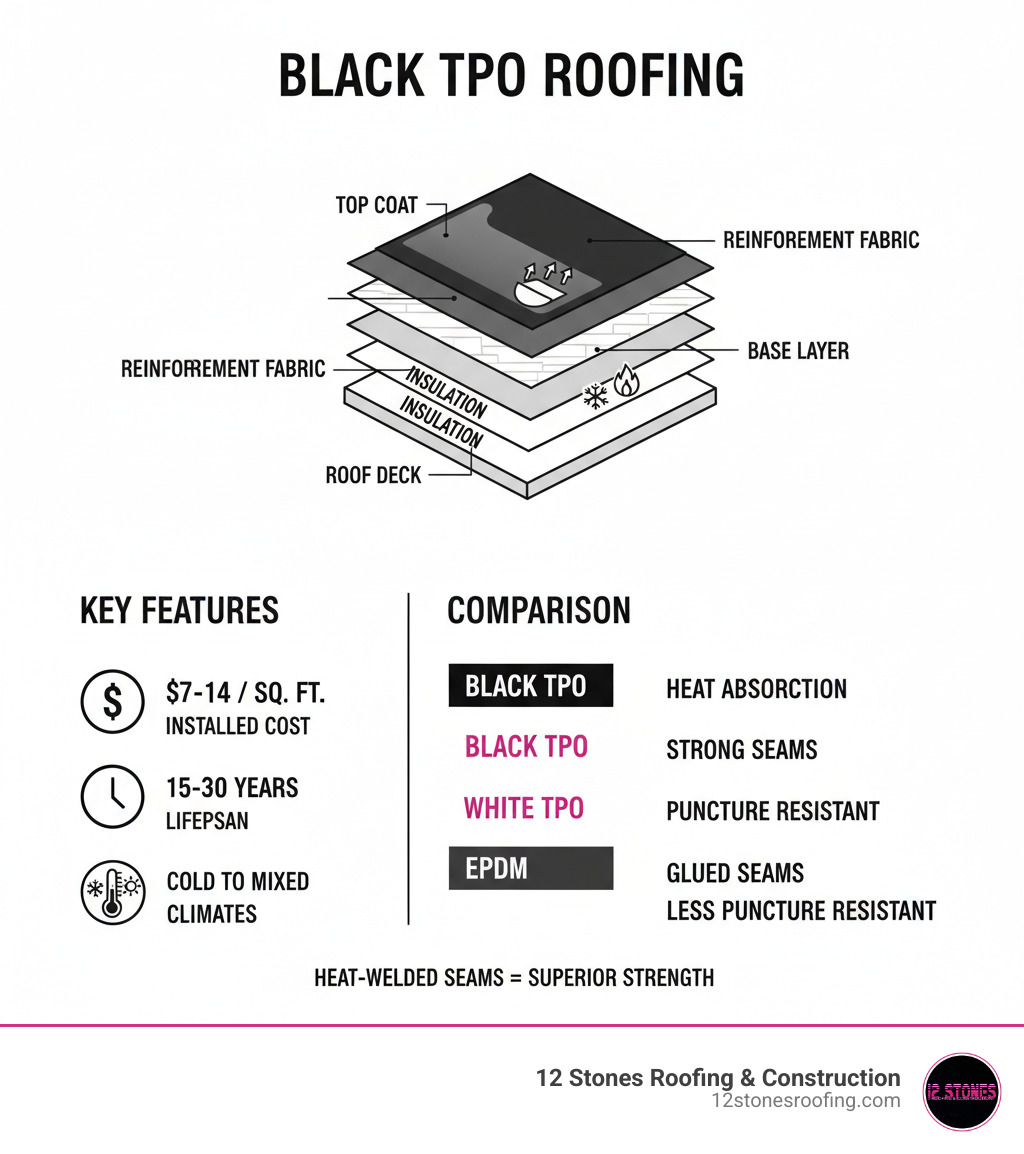
| Feature | Black TPO |
|---|---|
| Membrane thickness | 45, 60, or 80 mil |
| Typical installed cost | $7.00 – $14.00 per sq. ft. |
| Expected lifespan | 15 – 30 years |
| Best climate | Cold to mixed climates |
| Seam type | Heat-welded (stronger than glued) |
| Recyclable | Yes, 100% |
| Energy Star rated | Available with UV-stabilized formulations |
| Key advantage over EPDM | Stronger seams, better puncture resistance |
Most commercial building owners in Texas think of TPO as that bright white membrane you see on flat-roofed warehouses and strip malls. And they’re right — white TPO dominates the market because it reflects sunlight and cuts cooling costs in hot climates. However, TPO roofing is not a one-size-fits-all solution.
But black TPO tells a different story.
It absorbs heat. It melts ice faster. It evaporates condensation quickly. And in the right applications, it can actually lower your heating costs while delivering the same tough, weld-sealed performance that has made TPO the largest and fastest-growing segment in commercial roofing.
The challenge? Most property owners — even experienced ones — don’t know black TPO exists, let alone when it makes more sense than white TPO or traditional black EPDM rubber roofing.
That’s exactly what this guide covers.
I’m Jason Roberts, owner of 12 Stones Roofing & Construction — a Service-Disabled Veteran-Owned firm based in Pasadena, Texas — and over the past decade I’ve installed and evaluated black TPO roofing systems across commercial and industrial properties throughout the Gulf Coast region. In this guide, I’ll walk you through everything: composition, climate performance, cost, installation standards, and which manufacturers produce the best black TPO membranes on the market today.
Black TPO roofing terms to remember:
Understanding the Composition of Black TPO Roofing
To understand why Black TPO roofing is gaining traction, you first have to look at what’s inside the roll. TPO stands for Thermoplastic Polyolefin. Despite the “rubber” feel, it is actually a blend of polypropylene (a plastic) and ethylene-propylene rubber.
These membranes are engineered in three distinct layers:
- A Base Layer: Provides the foundation for the sheet.
- Polyester Scrim: A reinforcement fabric sandwiched in the middle that gives the membrane its “muscle”—improving tear and puncture resistance.
- The Top Performance Layer: This is where the magic happens. In black TPO, this layer is infused with carbon black and specialized UV stabilizers to prevent the sun from “cooking” the polymer chains over time.
According to technical specifications for Black TPO roofing, the quality of this top layer is everything. Some premium products, like Duro-TECH, offer a 30-mil top performance layer on a 60-mil sheet—the thickest in the industry—which directly correlates to how many years of Texas sun the roof can handle before it begins to degrade.
Key Differences from Standard White TPO
The primary difference between black and white TPO roofing is how they interact with the sun. White TPO is a “cool roof” champion, designed for high solar reflectivity (bouncing light away) and high thermal emittance (releasing absorbed heat).
Black TPO roofing, conversely, is designed for heat absorption. While it still contains UV inhibitors to prevent material breakdown, it lacks the reflective pigments that keep white roofs cool. This leads to higher solar gain, which can be a strategic advantage depending on your building’s location and heating requirements.
Why TPO Outperforms Black EPDM
For decades, if you wanted a black flat roof, you bought EPDM (Ethylene Propylene Diene Monomer). However, Black TPO roofing has several structural advantages over EPDM:
- Heat-Welded Seams: EPDM seams are held together with adhesive tape or glue, which can eventually dry out and fail. TPO seams are fused together using hot-air welders at temperatures exceeding 900°F. This creates a monolithic bond that is actually stronger than the membrane itself.
- Puncture Resistance: Because TPO is reinforced with a heavy-duty polyester scrim, it is significantly harder to puncture than non-reinforced EPDM.
- Chemical Resistance: TPO handles exposure to grease, oils, and certain chemicals better than standard rubber roofs, making it a preferred choice for buildings with rooftop exhaust systems.
| Performance Metric | Black TPO | White TPO | Black EPDM |
|---|---|---|---|
| Seam Strength | High (Welded) | High (Welded) | Moderate (Adhesive) |
| Puncture Resistance | Excellent | Excellent | Moderate |
| Heat Absorption | Very High | Very Low | Very High |
| Recyclability | 100% | 100% | Low |
Strategic Advantages for Cold Climates
While we at 12 Stones Roofing & Construction primarily serve the Pasadena and La Porte areas, we often consult on projects across different regions. In northern climates, Black TPO roofing is often the superior choice over white.
The “dark side” of durability comes from the roof’s ability to act as a thermal mass. In regions where “heating degree days” far outnumber “cooling degree days,” a black roof can provide a significant boost to a building’s energy balance.
Energy Efficiency of Black TPO Roofing in Northern Climates
In colder environments, a white roof can actually be a liability. It reflects the sun’s warmth during the winter, forcing the building’s HVAC system to work harder to maintain interior temperatures. By choosing Black TPO roofing, owners take advantage of solar heat gain. This “passive heating” can lead to a measurable reduction in annual heating costs.
Furthermore, a black surface helps maintain the temperature of the insulation below it, optimizing the R-value of the entire roofing assembly during the winter months.
Managing Snow, Ice, and Moisture
One of the most common TPO roof membrane problems in cold weather is the buildup of condensation. Because white roofs stay so cool, moisture can get trapped between the membrane and the insulation, leading to mold or “wet insulation” syndrome.
Black TPO solves this by:
- Rapid Snow Melt: Darker colors absorb solar radiation, melting ice and snow much faster than white surfaces. This reduces the structural load on the building and clears drainage paths more efficiently.
- Condensation Evaporation: The increased surface temperature helps evaporate moisture that might otherwise collect under the membrane, protecting the deck from rot.
Installation and Durability Standards
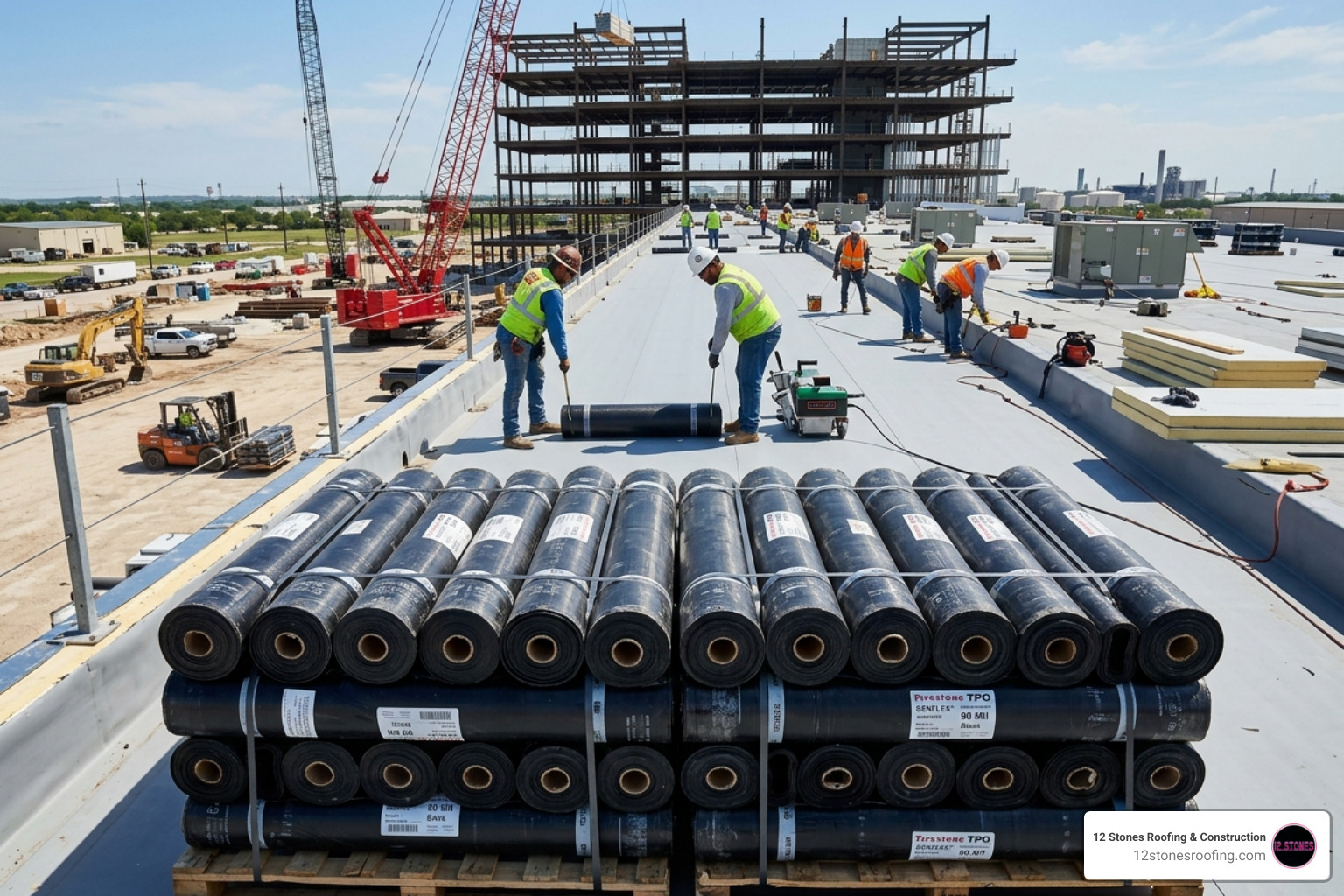
Installing Black TPO roofing isn’t as simple as rolling out a tarp. It requires specialized equipment and a deep understanding of thermoplastic properties. In our service areas like Deer Park and Pasadena, we ensure every installation meets rigorous ASTM D6592 compliance standards.
Professional Installation Standards for Black TPO Roofing
There are three primary ways we secure these systems:
- Mechanically Fastened: The membrane is attached to the roof deck using heavy-duty screws and plates. This is the most common method and works well for most commercial structures.
- Fully Adhered: The membrane is glued to the substrate using specialized adhesives. This provides the highest wind-uplift resistance and a smooth, aesthetic finish.
- Induction Welding: Using technology like RhinoBond, we can weld the membrane to the plates beneath it without penetrating the top layer of the TPO.
For local business owners, choosing professional TPO roofing installation in Pasadena is critical. If the heat welder is set even a few degrees too low, the seams won’t fuse; too high, and you’ll burn the membrane.
Long-Term Performance and UV Resistance
A common myth is that black roofs degrade faster because they get hotter. While heat can accelerate aging, modern Black TPO roofing is engineered with advanced weathering packages. Technologies like Versico’s OctaGuard XT use a blend of eight different stabilizers to protect against heat and UV degradation.
With a proper maintenance plan, a 60-mil or 80-mil black TPO roof can easily reach a 25 to 30-year lifespan. These systems also carry a Class-A fire rating, providing peace of mind for high-occupancy commercial buildings.
Cost Analysis and ROI
When you’re looking at the bottom line, Black TPO roofing is remarkably competitive. On average, a professional installation costs between $7.00 and $14.00 per square foot, depending on the complexity of the roof and the thickness of the membrane chosen.
Manufacturer Options and Customization
Several major manufacturers dominate the TPO space:
- GAF EverGuard: Known for their vast distribution and reliable warranties. GAF EverGuard TPO Color Membranes (including black) often require a minimum order of 400 squares (40,000 sq. ft.) with a 4-6 week lead time.
- Carlisle Sure-Weld: Offers a wide TPO color palette and is a leader in single-ply technology.
- Johns Manville: Their TPO-SA (Self-Adhered) options can install up to three times faster than traditional methods, which can significantly lower your TPO installation labor costs.
Maintenance and Warranty Protection
To protect your investment, we recommend bi-annual inspections—typically in the spring and fall. We look for:
- Seam Integrity: Ensuring the heat-welded bonds remain tight.
- Flashing Checks: Inspecting the areas around vents, pipes, and HVAC units.
- Drainage: Clearing debris to prevent ponding water.
Many manufacturers offer 20-year No Dollar Limit (NDL) warranties, which cover both materials and labor for repairs. For property managers seeking TPO roofing in Pasadena, TX, these warranties are the ultimate safeguard against the unpredictable Texas weather.
Frequently Asked Questions about Black TPO
How long does a black TPO roof typically last?
A high-quality Black TPO roofing system typically lasts between 15 and 30 years. The actual lifespan depends heavily on the membrane thickness (80-mil lasts longer than 45-mil), the quality of the initial installation, and whether the owner performs routine maintenance.
Is black TPO more expensive than white TPO?
Generally, no. There is price parity between standard white and black TPO membranes. The cost fluctuations usually come from the thickness of the sheet or the specific adhesive system used, rather than the color itself. However, for smaller projects, some manufacturers may charge a premium or require minimum order sizes for non-standard colors.
Can black TPO be recycled?
Yes! TPO is 100% recyclable. During the manufacturing process, scrap is often ground up and fed back into the production line. At the end of the roof’s life, the membrane can be removed, cleaned, and processed into new roofing products or other plastic goods. This makes it a great choice for companies pursuing LEED credits or sustainable building goals.
Conclusion
Black TPO roofing is more than just an aesthetic choice; it is a high-performance engineering solution for commercial buildings that need strength, weldability, and heat absorption. Whether you are looking to save on heating costs in a cooler climate or you simply prefer the sleek, low-profile look of a dark roof for your industrial facility, black TPO delivers.
At 12 Stones Roofing & Construction, we bring veteran-owned precision to every commercial project. We understand the local codes in Pasadena and La Porte, and we know exactly how to install a roof that stands up to the Texas elements while protecting your bottom line.
Ready to see if Black TPO roofing is the right move for your building?
Contact us today for a free, transparent estimate.