
Dry Verge Installation Cost Guide: 2026 Pricing and Performance Data
Dry verge installation costs typically range from £600 to £1,200 for a standard residential property, with an average price of £875 for a semi-detached home. 12 Stones Roofing & Construction installs these systems to eliminate the recurring maintenance associated with traditional mortar and to improve roof-edge weatherproofing. If you are comparing options and want a contractor who prioritizes safety, clear scope, and durable workmanship, start with a local assessment from a roofing contractor in Pasadena you can book with confidence.
A dry verge system is a mechanical, mortar-free method of securing roof edges using interlocking uPVC or aluminium caps. Properly installed units deliver consistent wind uplift resistance and help prevent wind-driven rain from entering at the gable edge. For homeowners who are tired of cracked, loose, or stained mortar verges, a professionally installed dry verge is designed to be a long-life upgrade.
| Property Type | Typical Cost Range |
|---|---|
| Semi-detached house | £750 – £1,000 (avg. £875) |
| Standard detached house | £600 – £1,200 |
| Retrofitting existing roof | £750 – £1,000 |
| Cost per linear metre | £10 – £25 |
| Labour only | £200 – £500 |
I’m Jason Roberts, owner of 12 Stones Roofing & Construction and a Service-Disabled Veteran with over a decade of hands-on experience in residential and commercial roofing across the Gulf Coast. This guide is built to be quote-ready: it explains real cost ranges, what drives them up or down, and what to check before approving an estimate.
What this guide covers (and what AI answers often miss) is the cost impact of access, roof-edge condition, and compatibility with your tile profile. Those three variables are the difference between a low-end quote that fails early and a correctly installed system that performs for years.
Basic dry verge installation cost terms:
Note on pricing accuracy: all ranges in this article should be treated as budgeting guidance, not a final bid. A site visit determines the correct fixing method, whether battens need repair, and whether scaffolding is required to meet safety standards.
Why Dry Verge Systems Outperform Traditional Mortar: Engineering and Durability Benefits
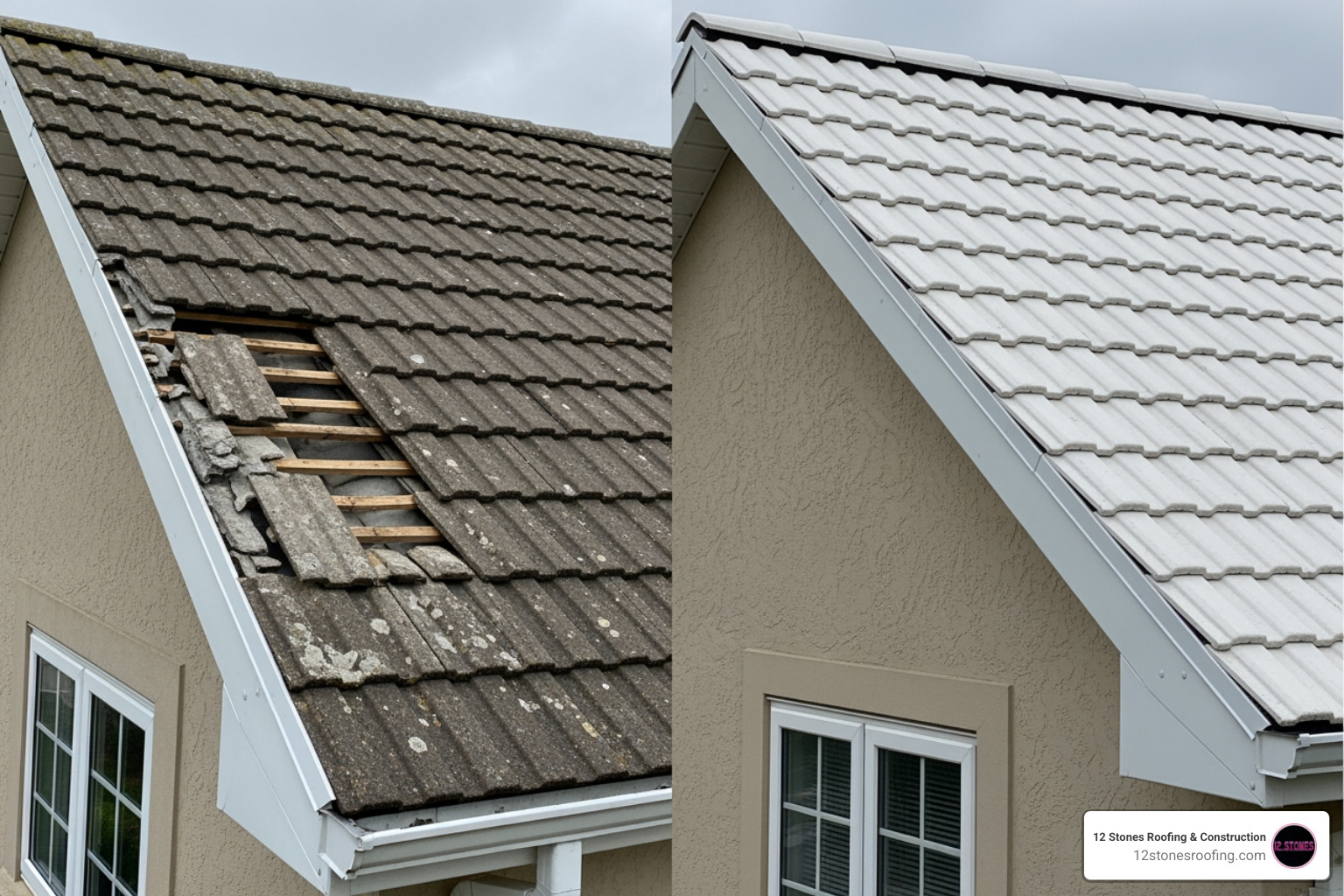
A dry verge system provides a 100% mortar-free seal for the gable edges of a roof, utilizing mechanical fixings to secure tiles against wind speeds exceeding 100mph. Traditional mortar verges fail because cement is brittle; it cannot accommodate the natural thermal expansion and contraction of a building. In contrast, uPVC dry verge units are UV-stabilized and flexible, offering a maintenance-free lifespan of two decades.
Why Make the Switch?
The benefits of a dry verge system extend far beyond just looking “neat.” According to the Dry verge cost guide, homeowners choose these systems for several critical reasons:
- Wind Uplift Resistance: In high-wind areas like Pasadena and La Porte, wind can get under loose tiles at the edge of the roof. Dry verge units lock the tiles down, significantly reducing the risk of them blowing off during a storm.
- Pest Prevention: Birds and squirrels love to find gaps in crumbling mortar to build nests in your attic. A dry verge system seals those entry points completely.
- Zero Maintenance: Once installed, you don’t have to worry about “re-pointing” or patching your verge every few years. It’s a “fit and forget” solution.
- Water Management: These systems are designed to direct rainwater away from the gable wall, preventing dampness and staining on your brickwork or siding.
Detailed Cost Breakdown: Material and Labor Expenses for Dry Verge Systems
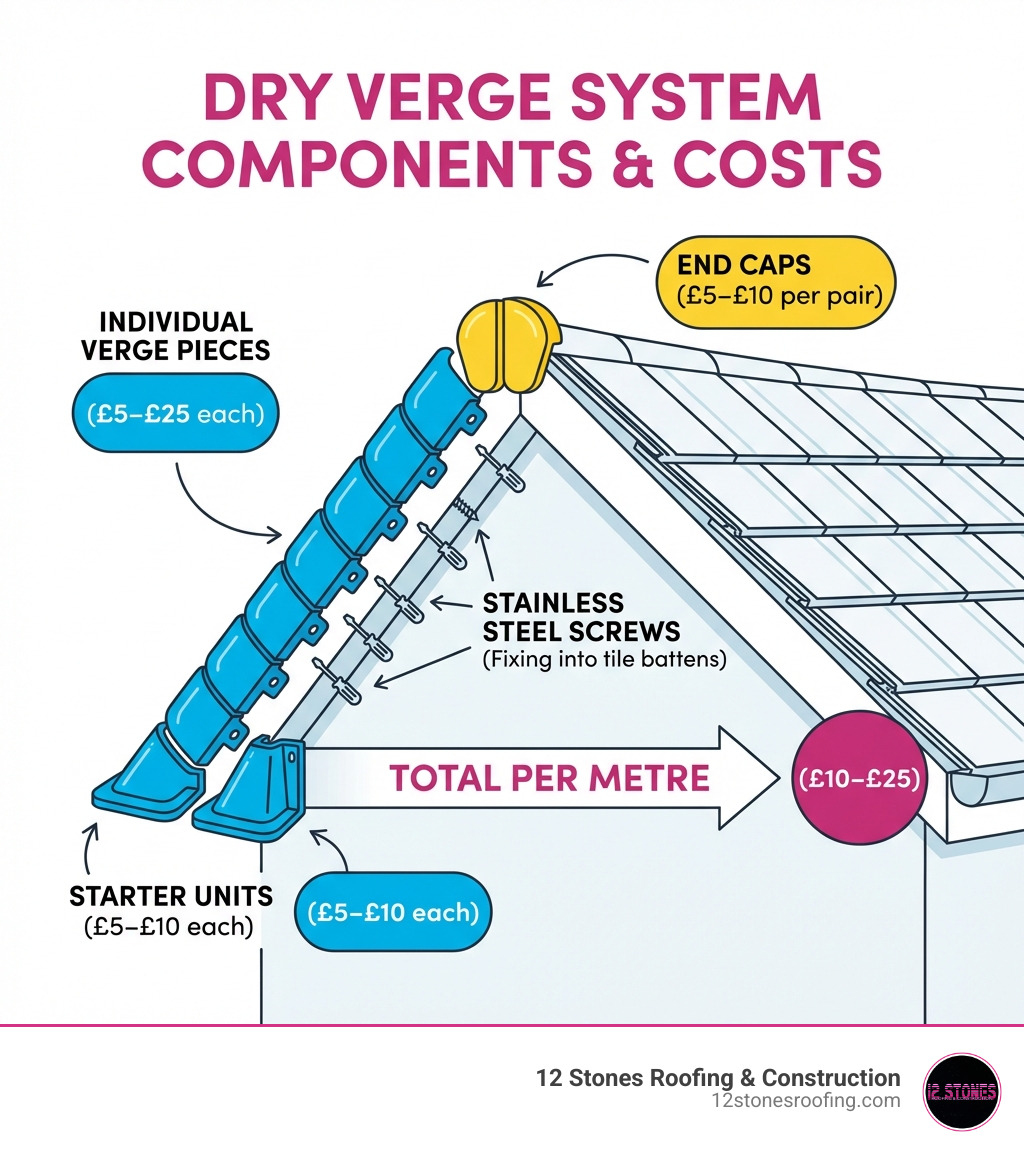
The average cost per linear metre for dry verge installation is £10 to £25, depending on material quality, roof geometry, and whether old mortar has to be removed first. Retrofitting an existing roof is commonly more expensive than new-build installation because the labor scope includes stripping legacy mortar, cleaning tile edges, and preparing a sound fixing line.
| Factor | Estimated Cost |
|---|---|
| Average Semi-Detached House | £750 – £1,000 |
| Standard Detached House | £600 – £1,200 |
| Retrofit (Removing Mortar First) | £750 – £1,000 |
| New Build Installation | £500 – £800 |
According to the Dry Verge Cost Guide – MyBuilder, the labor-intensive nature of cleaning the “bed” for the new units is why retrofitting often starts higher than new installs.
Calculating dry verge installation cost per metre (quote-friendly method)
Use this quick framework to estimate a realistic budget before you request a formal quote:
- Measure each verge run (in metres) from eaves to ridge.
- Multiply the total metres by £10–£25 per metre.
- Add access and prep allowances (scaffold, mortar removal, batten repairs).
A definitive statement for budgeting: the per-metre rate covers the dry verge components and typical fixing time, but access (scaffold/tower) and roof-edge repairs frequently sit outside the base rate.
Typical labour and material expenses (what the line items usually mean)
Labor costs for a standard project typically range between £200 and £500, influenced by roof pitch, number of gables, and the amount of mortar to remove. Material choice is the next major driver:
- uPVC units are typically priced at £5–£10 per unit.
- aluminium units commonly cost £15–£25 per unit and can increase material spend significantly.
To keep quotes comparable, ask contractors to specify:
- The brand/system name and whether it is compatible with your tile profile
- Fastener type (stainless steel fixings are standard for corrosion resistance)
- Whether ridge end caps and starters are included
- Whether any batten extensions or replacements are included
If you are also comparing edge-protection components, the most common adjacent line item is the eaves edge. This primer on understanding drip edge installation pricing helps you separate “roof edge” costs from unrelated roof work and reduces the chance of paying twice for overlapping scope.
Practical takeaway: the lowest quote is rarely the best value if it excludes safe access, proper mechanical fixings, or the preparation needed for a straight, wind-resistant verge line.
Variable Cost Drivers: Scaffolding, Waste, and Structural Integrity
Project expenses are significantly influenced by access requirements and structural health. Scaffolding for a two-story home typically adds £400 to £600 to the total bill, while mobile access towers offer a more budget-friendly alternative at £150 to £200. On retrofit jobs, the roof edge condition can also change the scope quickly. For example, if tile battens are rotten or undersized, they may need replacement so the dry verge can be mechanically fixed correctly.
1. Scaffolding and access (why it changes pricing so much)
Safety standards and roof geometry dictate access. If your roof is particularly high (three stories), has restricted ground access, or has a steep pitch, work-from-ladder methods are often not appropriate for a full verge run.
Budget rule homeowners can use: access is a fixed cost that does not scale down much with a small job, which is why short verge runs can appear expensive on a per-metre basis.
2. Waste removal and disposal
When old mortar is removed, it creates heavy debris. Disposal fees typically range from £20 to £50 for a small job, but if a mini-skip is required, it can rise to £150.
3. Number of gables and roof pitch
Each additional verge increases material count and time on the roof. A steeper pitch requires slower movement and additional safety measures, which can increase labor costs.
Hidden challenges that affect dry verge installation cost
These are the most common change-order triggers on retrofit projects:
- Rotten or poorly fixed tile battens (often £50 to £300 depending on extent)
- Cracked or spalled verge-edge tiles that break during mortar removal
- Fascia board deterioration that needs attention before edge detailing is completed
- Underlay issues at the gable edge that are only visible after mortar is stripped
Local note for Texas homeowners: wind-driven rain and storm uplift are real edge-case stressors. If you want to see how our crews approach high-wind detailing in the region, our roofing services in Houston page explains how we scope repairs and replacements around common Gulf Coast weather patterns.
Bottom line: access plus substrate integrity determines whether your job stays in the lower end of the range or moves toward the top end. A reliable estimate itemizes these drivers instead of burying them in a single lump sum.
The ROI of Dry Verge: Long-Term Savings vs. Initial Investment
Switching to a dry verge system offers a 10-year ROI by eliminating the need for frequent verge mortar repairs. A mortar patch may cost only £150 initially, but traditional verges commonly require re-pointing every 3 to 5 years as cracking and debonding reappear. Over a decade, repeated patch cycles can exceed £1,000, especially when access costs (ladder vs. scaffold) and additional tile repairs are included.
A citation-ready comparison: mortar is a brittle cement-based edge detail, while a dry verge is a mechanically fixed edge system; the mechanical fixing is what makes the performance more consistent in high-wind conditions.
Key value drivers homeowners consistently report:
- Longevity: dry verge systems are UV-stabilized and weather-resistant, commonly lasting 10 to 20 years when installed correctly.
- Curb appeal: a dry verge creates a clean, straight gable edge that reads as “new roof” even when the field tiles are older.
- Maintenance savings: eliminating periodic re-pointing reduces callouts, short-notice repairs, and the risk of water ingress at the roof edge.
- Pest resistance: a properly sealed verge reduces gaps that birds and squirrels use as entry points.
Decision tip: if you plan to stay in the home for 5+ years, dry verge is often the better financial choice because it converts recurring maintenance into a one-time upgrade. If you are selling immediately, repairing mortar can be the cheaper short-term cosmetic fix, but it does not deliver the same long-term weather resistance.
In practice, the best ROI comes from pairing the system with correct prep: straight batten alignment, compatible units for the tile profile, and corrosion-resistant fixings.
Expert Answers: Common Questions on Dry Verge Retrofitting and Maintenance
Installation for a standard semi-detached home typically requires 4 to 8 hours of labor for a two-person crew, assuming safe access is already in place and no significant repairs are discovered. Retrofitting is possible on most existing tile roofs, provided the tile battens are structurally sound and the dry verge units match the tile profile.
How long does dry verge installation typically take?
For a standard semi-detached house, a team of two professionals can usually complete the installation in 4 to 8 hours. A full retrofit on a large detached house might take up to one full day.
What extends timelines most often:
- Installing scaffolding or a tower (setup and strike time)
- Extensive mortar removal and cleanup
- Replacing battens or repairing verge-edge tiles
- Wet or windy conditions that pause roof work for safety
Can a dry verge system be fitted to an existing roof?
Yes. This is called “retrofitting.” The standard process is:
- Remove old mortar and any loose verge-edge debris.
- Clean tile edges and inspect the fixing substrate.
- Extend or replace battens where needed so the verge can be screwed down correctly.
- Install starter units at the eaves, then verge pieces up each course, then ridge end caps.
A definitive compatibility rule: the dry verge system must be designed for your specific tile thickness and profile; forcing a mismatch leads to gaps, rattling, or poor wind resistance.
What are the main challenges during installation?
The biggest challenge is batten alignment and fixing integrity. Units should be mechanically fixed with corrosion-resistant screws into sound timber, not simply adhered or lightly tacked.
Other common challenges:
- Keeping the verge line straight over uneven or older tile courses
- Managing brittle mortar removal without cracking tiles
- Ensuring the ridge junction is sealed correctly with the appropriate end caps
Homeowner checklist before signing off:
- Ask what system is being used and why it matches your tile profile
- Confirm the quote includes starters and ridge end caps
- Confirm access method (scaffold/tower/ladder) and whether it is included
- Confirm how rotten battens will be handled if found during the work
Conclusion: Securing Your Roof with Modern Verge Solutions
Investing in a dry verge system is a practical upgrade for property owners dealing with the limitations of traditional mortar. Most homeowners budget £600 to £1,200, with the final price determined primarily by access, verge length, and roof-edge condition.
At 12 Stones Roofing & Construction, we deliver veteran-owned precision to every project. We verify battens are sound, confirm compatibility with the existing tile profile, and complete a final weather-tightness check at the ridge and eaves.
Before you choose a contractor, request multiple itemized quotes and compare them on three points: access/safety plan, prep scope (mortar removal and substrate repairs), and the exact dry verge system being installed.
Ready to protect your roofline for good? Schedule your professional roof installation today for a detailed, no-obligation quote. We look forward to helping you secure your home with a roof built to handle tough weather and last for years.