
What Is 16 Gauge Corrugated Sheet Metal — and Why Does It Matter for Your Roof?
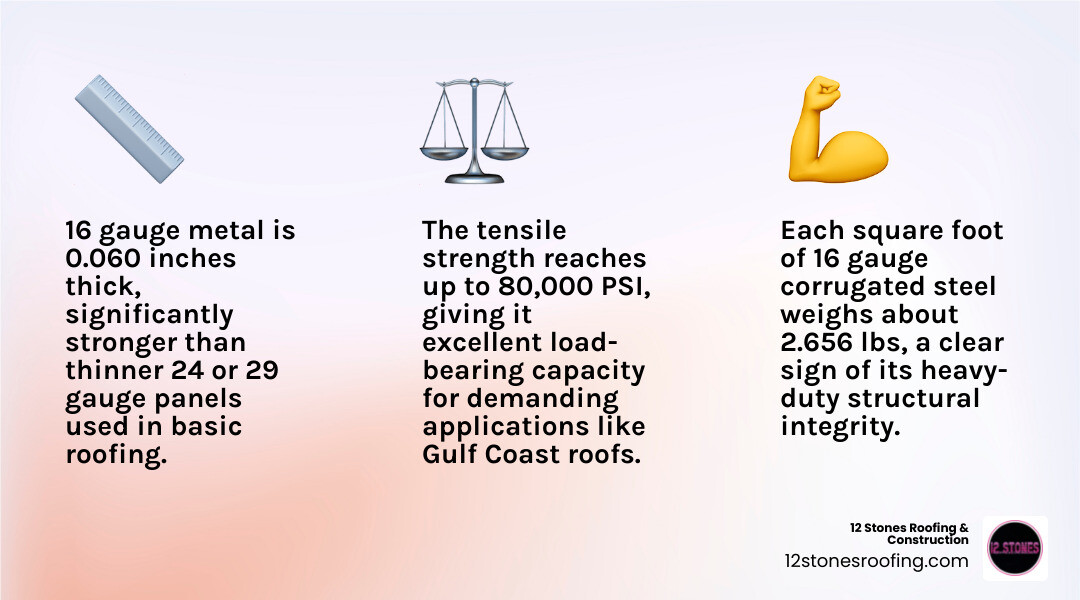
16 gauge corrugated sheet metal is a heavy-duty structural material with a nominal thickness of 0.060 inches (1.52 mm). It is engineered for high-stress environments, offering a tensile strength between 58,000 – 80,000 PSI. As a premier roofing contractor in Pasadena, 12 Stones Roofing & Construction utilizes this gauge for industrial and commercial applications where maximum durability and wind resistance are non-negotiable.
Here’s a quick snapshot of what makes it stand out:
| Feature | Specification |
|---|---|
| Thickness | 0.060 inches (1.52mm) |
| Weight | ~2.656 lbs per sq ft |
| Tensile Strength | 58,000 – 80,000 PSI |
| Common Material | Galvanized Steel (ASTM A653) |
| Typical Sizes | 4×8 ft sheets, up to 16 ft lengths |
| Key Benefit | High strength + corrosion resistance |
The corrugated profile isn’t just for looks. Those ridges dramatically increase the panel’s bending strength — making it far more rigid than a flat sheet of the same gauge. That matters a lot when you’re dealing with heavy wind, hail, or the punishing Gulf Coast storms common in Southeast Texas.
If you’re a property owner in Pasadena or the surrounding area dealing with roof damage or looking to upgrade to a long-lasting metal roof, understanding gauge thickness is the first step toward making the right material decision. Our metal roofing services at 12 Stones Roofing & Construction are built around exactly these kinds of decisions.
I’m Jason Roberts, owner of 12 Stones Roofing & Construction — a Service-Disabled Veteran-Owned firm based in Pasadena, Texas, with over a decade of hands-on experience specifying and installing 16 gauge corrugated sheet metal and other metal roofing systems for both residential and commercial clients across the Gulf Coast. In this guide, I’ll walk you through everything you need to know — from specs and materials to installation and cost — so you can make a confident, informed choice.
Understanding 16 Gauge Corrugated Sheet Metal Specifications
When we talk about “gauge” in the metal world, it can be a bit counterintuitive. In the metal industry, a lower gauge number actually means a thicker piece of metal. So, while a 29 gauge panel is common for basic sheds, 16 gauge corrugated sheet metal is significantly thicker and more robust.
Specifically, 16 gauge steel has a nominal thickness of approximately 0.060 inches. According to industry standards like the AISI tolerance range, this can fluctuate slightly between 0.0635″ and 0.0695″, but for most structural calculations, we stick to that 0.060″ mark. Because it is so thick, it carries a substantial weight of about 2.656 lbs per square foot. This weight is a clear indicator of its structural integrity; when you hold a piece of 16 gauge metal, you can feel the difference in quality compared to thinner residential alternatives.
Most of these sheets are manufactured to meet ASTM A653 standards, ensuring they have the mechanical properties and zinc coating required for long-term outdoor exposure. Whether you are looking for Galvanized Steel Sheet Gauge 16 for a commercial warehouse or a specialized industrial project, the specifications remain the gold standard for heavy-duty protection.
At 12 Stones Roofing & Construction, we often help clients in Pasadena and La Porte navigate these technical details. Choosing the right gauge is the difference between a roof that lasts 20 years and one that lasts 50.
Comparing Common Roofing Gauges
To help you visualize how 16 gauge stacks up against more common residential roofing materials, take a look at the table below:
| Gauge | Thickness (Inches) | Weight (lbs/sq ft) | Common Use |
|---|---|---|---|
| 16 Gauge | 0.060″ | 2.656 | Heavy Industrial, Roof Decks, Truck Beds |
| 24 Gauge | 0.024″ | 1.150 | High-end Residential Standing Seam |
| 26 Gauge | 0.018″ | 0.900 | Standard Residential Metal Roofing |
| 29 Gauge | 0.014″ | 0.750 | Agricultural Buildings, Sheds |
Durability of 16 Gauge Corrugated Sheet Metal
The longevity of 16 gauge corrugated sheet metal is largely due to its material treatments. Most 16 gauge panels are “hot-dipped” in a zinc coating. This process creates a metallurgical bond, providing what we call “sacrificial protection.” Essentially, if the metal gets scratched, the zinc will corrode first to protect the underlying steel from rust.
For those looking for an even more specialized look and feel, Corten steel (A606-4) is a popular 16 gauge option. Corten is a weathering steel that arrives un-rusted but develops a stable, rust-like appearance when exposed to the elements. This “rust” actually acts as a protective layer, preventing deeper corrosion.
In industrial settings, many manufacturers offer a 10-year guarantee on color and even longer on structural integrity. When installed correctly by a professional team, these heavy-gauge sheets are designed to withstand the high humidity and salt air we experience here in the La Porte and Pasadena areas.
Material Composition and Structural Performance

While galvanized steel is the most common material for 16 gauge corrugated sheet metal, it’s far from the only option. Depending on your specific needs—whether it’s for a chemical plant near the ship channel or a coastal home—different alloys offer unique benefits.
- Galvanized Steel: Carbon steel coated in zinc. It is the workhorse of the industry, offering a balance of cost and corrosion resistance.
- Stainless Steel: Used in highly corrosive environments. It’s significantly more expensive but virtually impervious to rust.
- Aluminum: Lightweight and naturally rust-resistant, though 16 gauge aluminum is less common for roofing than steel because steel offers higher impact resistance.
- Galvalume: A coating of zinc, aluminum, and silicon. It often lasts longer than standard galvanization in coastal environments.
You can find high-quality 16 Gauge Galvanized Steel Corrugated Sheet products that are specifically engineered as building materials with high-yield strengths.
Structural Benefits of the Corrugated Profile
Why corrugate the metal at all? If you take a flat 16 gauge sheet, it’s quite strong, but it can still flex over long spans. By “folding” the metal into a corrugated U-shape or V-shape profile, you increase its bending strength perpendicular to the ridges.
This profile allows the metal to achieve a tensile strength of 58,000 to 80,000 PSI. In practical terms, this means 16 gauge corrugated panels can support significant weight—such as heavy snow loads (not that we see much of that in Pasadena!) or, more importantly for us, the high-pressure winds of a hurricane. The corrugations act like a series of mini-beams, providing exceptional structural integrity and load-bearing capacity that flat panels simply can’t match.
Industrial and Construction Applications
Because of its extreme thickness and strength, 16 gauge corrugated sheet metal isn’t usually the first choice for a standard suburban house—it’s often “overkill.” However, it is the go-to choice for industrial and heavy commercial applications.
Common uses include:
- HVAC Ductwork: Large-scale industrial ventilation systems that require rigid, moisture-resistant paths.
- Truck Beds and Trailers: The 16 gauge thickness provides a rugged surface that can handle heavy equipment without denting.
- Roof Decks: Used as the structural “floor” of a roof system in commercial buildings, which is then covered with insulation and a membrane.
- Agricultural Barns: For large-span buildings where the panels must provide structural support between purlins.
- Heavy-Duty Siding: For warehouses located in high-traffic industrial zones where impact resistance is a priority.

If you are planning a large-scale project, our Metal Roof Installation Service Guide 2026 provides a deeper dive into how these heavy materials are integrated into modern building designs.
Standard Sizes for 16 Gauge Corrugated Sheet Metal
When ordering these panels, you’ll typically find them in standard widths of 36 inches or 48 inches. The most common “stock” size for flat sheets is 4×8 ft, but for roofing and siding, we often use much longer panels.
Retailers and specialized suppliers often stock 16 gauge panels in lengths up to 16 ft. Having these longer lengths is a huge advantage because it reduces the number of “laps” or seams on your roof. Fewer seams mean fewer places for water to potentially sneak in—a vital consideration for Corrugated Metal Roof Installation in the rainy Texas climate. Custom cutting is also widely available, allowing us to fit panels perfectly to the unique dimensions of your structure.
Selection and Installation for Texas Weather
In Pasadena and La Porte, our roofs have to deal with intense heat, high humidity, and the occasional tropical storm. When selecting 16 gauge corrugated sheet metal, there are several local factors we always consider.
Thermal Expansion
Metal expands when it gets hot and contracts when it cools. Because 16 gauge metal is thicker and heavier, the force of this expansion is significant. We use specialized fasteners with neoprene washers that allow for slight movement while maintaining a watertight seal.
Fastener Patterns
In high-wind zones, the way you screw down the metal is just as important as the metal itself. For 16 gauge panels, we use a denser fastener pattern to ensure the wind cannot get under the “ribs” of the corrugation and peel the panel back.
Installation Over Existing Materials
Many clients ask if they can install metal over their current roof. While it is possible, there are specific steps to follow. You can read more about the Best Way to Put Metal Roof Over Shingles on our blog. However, with the weight of 16 gauge metal (2.6 lbs per sq ft), we must first verify that your building’s structural frame can handle the added load.
Cost Analysis and Value Comparison
There is no getting around it: 16 gauge corrugated sheet metal is more expensive upfront than 26 or 29 gauge metal. You are paying for more steel per square foot.
However, the “value” comes in the Life Cycle Cost. A 29 gauge agricultural panel might need replacing after 15-20 years if it sustains hail damage or rust. A 16 gauge galvanized or Corten panel is likely to last 50 years or more with minimal maintenance.
- Weight Factors: Shipping costs are higher for 16 gauge because of the weight.
- Labor: Installation requires more effort and often more than one person per panel because of the weight of 16-foot sections.
- Long-Term ROI: For industrial properties, the reduction in maintenance and the increased protection against storm damage often make 16 gauge the most cost-effective choice over several decades.
For a detailed breakdown of how metal compares to other materials, check out our Metal Roof Replacement Cost Complete Guide.
Frequently Asked Questions about 16 Gauge Metal
How thick is 16 gauge corrugated sheet metal in inches?
16 gauge steel is approximately 0.060 inches thick. To put that in perspective, it’s about the thickness of a standard penny. While that might sound thin, in sheet metal, it is considered very heavy-duty.
Is 16 gauge thicker than 24 gauge for roofing?
Yes, significantly. In metal gauges, the lower the number, the thicker the metal. 16 gauge (0.060″) is more than twice as thick as 24 gauge (0.024″). While 24 gauge is the premium standard for residential standing seam roofs, 16 gauge is typically reserved for structural or industrial use.
What are the most common uses for 16 gauge corrugated panels?
In our experience around Pasadena, we see 16 gauge used most often for industrial roof decking, heavy-duty siding for commercial warehouses, and specialized applications like truck bed liners or perforated security screens.
Conclusion
Choosing 16 gauge corrugated sheet metal is a commitment to strength and longevity. Whether you’re protecting an industrial facility near the La Porte docks or building a structure meant to last a lifetime, this material provides the structural “backbone” that thinner gauges simply can’t offer.
At 12 Stones Roofing & Construction, we take pride in helping our neighbors in Pasadena, TX, and the surrounding areas navigate the complexities of metal roofing. We understand the local building codes, the specific challenges of our Gulf Coast weather, and the importance of a roof that doesn’t just look good but performs under pressure.
If you’re ready to discuss your next project or need an expert opinion on whether 16 gauge is right for you, we’re here to help. We provide transparent, reliable service backed by our local expertise and veteran-owned values.
Contact us today to schedule a consultation! Visit our Metal Roofing page to learn more about our specialized systems. Let’s build something that lasts.