
What Is 90 Mil EPDM Roofing — And Is It Right for Your Building?
90 mil EPDM roofing is a heavy-duty synthetic rubber membrane that is approximately 0.090 inches thick — roughly the thickness of two stacked dimes — and is one of the most durable single-ply roofing options available for flat and low-slope commercial buildings.
Here is a quick snapshot of what makes it stand out:
| Feature | 90 Mil EPDM at a Glance |
|---|---|
| Thickness | 0.090 inches (2.29 mm) |
| Material | Ethylene propylene diene monomer (synthetic rubber) |
| Tensile Strength | Up to 1,604 psi |
| Elongation | Up to 426% before tearing |
| Brittleness Point | Passes at -49°F — stays flexible in extreme cold |
| Typical Warranty | 15 to 30 years depending on manufacturer and system |
| Best For | Low-slope commercial, industrial, and high-traffic roofs |
| Roll Size | Typically 10 ft wide × up to 100 ft long (1,000 sq ft per roll) |
EPDM has been used on commercial roofs across the United States for over 50 years. The 90 mil version is the thickest widely available option, offering superior puncture resistance, stronger seam integrity, and a longer service life than the more common 45 mil or 60 mil alternatives.
If your Pasadena-area building has a flat or low-slope roof that takes a beating from Texas heat, hail, or heavy foot traffic, the 90 mil thickness deserves serious consideration. Our professional Pasadena roofing services are built around helping property owners make exactly these kinds of decisions — with the right materials for the right roof.
I’m Jason Roberts, owner of 12 Stones Roofing & Construction, a Service-Disabled Veteran-Owned firm based in Pasadena, Texas, with over a decade of hands-on experience installing and specifying 90 mil EPDM roofing systems for commercial and industrial properties along the Gulf Coast. In this guide, I’ll walk you through everything you need to know — from thickness comparisons and installation best practices to long-term costs and maintenance — so you can make a confident, informed decision for your building.
90 mil epdm roofing terms to learn:
Understanding Membrane Thickness: 45 Mil vs. 60 Mil vs. 90 Mil
When designing or upgrading a commercial low-slope roof, selecting the right membrane thickness is one of the most critical decisions you will make. EPDM (ethylene propylene diene terpolymer) is highly valued for its elastomeric flexibility, but its ultimate resistance to physical damage and long-term weathering depends directly on its thickness.
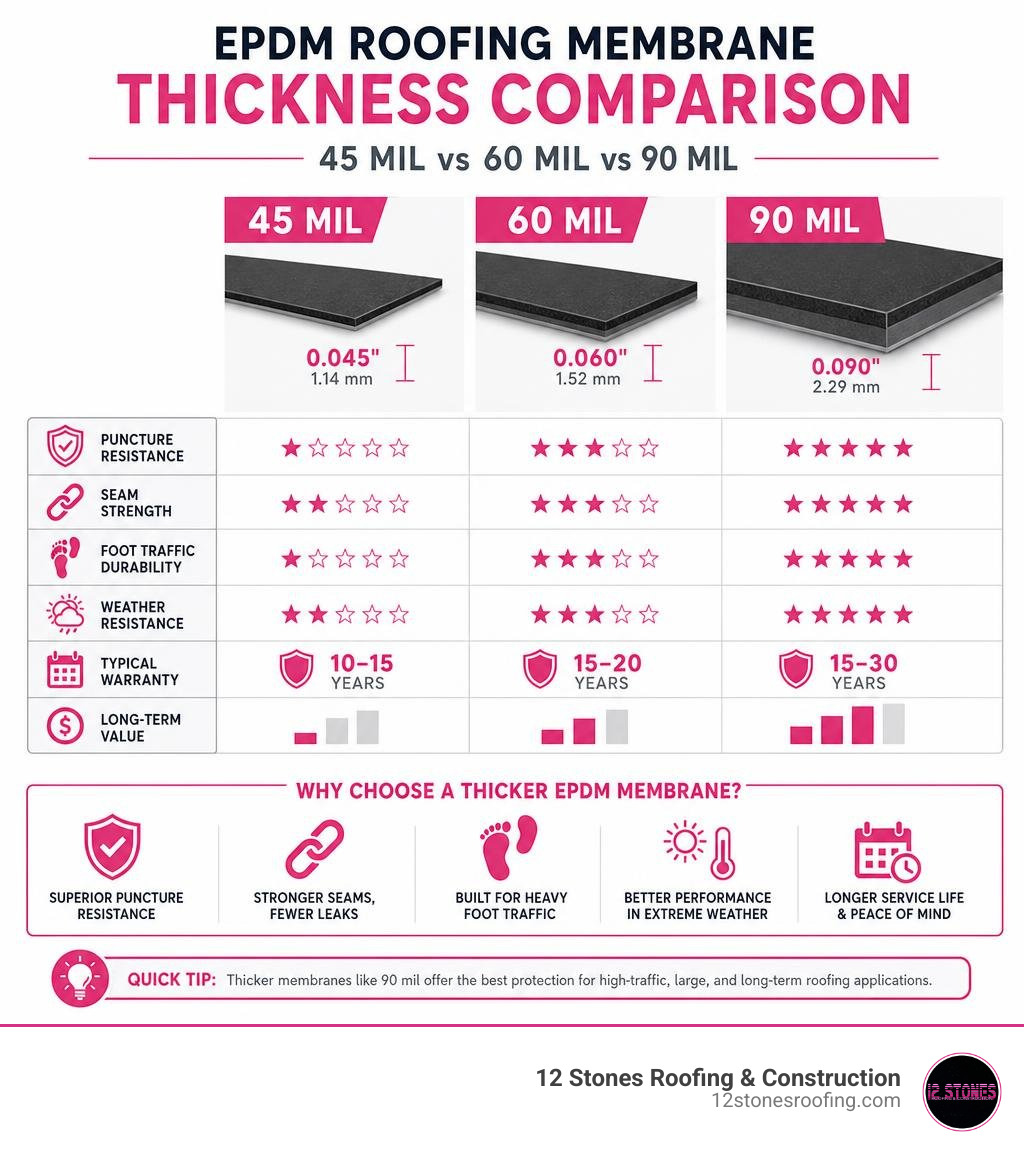
To help put these options into perspective, let’s look at how the three primary EPDM thicknesses compare across key performance metrics:
| Performance Metric | 45 Mil EPDM | 60 Mil EPDM | 90 Mil EPDM |
|---|---|---|---|
| Nominal Thickness | 0.045 inches (1.14 mm) | 0.060 inches (1.52 mm) | 0.090 inches (2.29 mm) |
| Puncture Resistance | Moderate | Good | Outstanding |
| Average Service Life | 12 to 20 years | 20 to 25 years | 30+ years |
| Weathering & UV Resistance | Standard | High | Maximum |
| Initial Material Cost | Lowest | Moderate | Higher upfront |
| Typical Warranty Terms | 10 to 15 years | 15 to 20 years | 20 to 30 years |
While thinner membranes have their place, they do not offer the same margin of safety as a heavy-duty system. Understanding these differences helps building owners determine whether a thinner, budget-friendly option is sufficient or if a thicker membrane is required to protect their investment.
What is 90 Mil EPDM Roofing?
A 90 mil EPDM roofing system utilizes a synthetic rubber membrane that is 0.090 inches (2.29 mm) thick. This represents the thickest standard non-reinforced elastomeric sheet available in the commercial roofing industry. Manufactured as a single-ply membrane, it is engineered from a high-performance ethylene propylene diene terpolymer compound.
The chemical structure of EPDM gives it an incredible ability to stretch and contour to unusual roof shapes, maintaining its physical properties even under extreme thermal stress. Unlike thinner alternatives, a 90 mil non-reinforced membrane provides an unobstructed, thick waterproofing layer without a fabric scrim that can sometimes reduce the net thickness of the actual water-impermeable rubber.
For projects requiring specialized sizing, you can source these heavy-duty rolls through specialized distributors like 90 mil EPDM Roofing. To learn more about the chemical history and evolution of this synthetic rubber, take a look at The EPDM Story: Everything You Need to Know About This Versatile Material.
Comparing Common EPDM Thicknesses
In commercial roofing, EPDM membranes are typically specified in three standard thicknesses: 45 mil, 60 mil, and 90 mil.
- 45 Mil EPDM: At just 0.045 inches thick, this is the thinnest standard option. While it is highly affordable and lightweight, it is more susceptible to accidental punctures from dropped tools, wind-blown debris, and severe hail. To determine if this entry-level thickness is appropriate for lighter applications, see our analysis on Is 45 Mil EPDM Rubber the Right Fit for Your Roof? and read our tips on Picking the Perfect 45 Mil EPDM Rubber Roof.
- 60 Mil EPDM: Measuring 0.060 inches thick, this is the industry standard for most new construction and re-roofing projects. It provides a balanced combination of durability and cost-effectiveness. Many commercial systems utilize reinforced variations, such as the JM EPDM R 60 MIL- FIT, which incorporates a tough polyester scrim to enhance tear resistance.
- 90 Mil EPDM: At 0.090 inches, this membrane is twice as thick as a 45 mil sheet. This added mass directly translates to a massive jump in puncture resistance, exceptional dimensional stability, and a significantly longer service life.
By investing in a thicker membrane, building owners dramatically reduce the frequency of repairs and delay the need for complete roof replacements by decades. For a comprehensive overview of how these thicknesses fit into the broader landscape of single-ply rubber, read about EPDM Rubber Roofing Materials.
The Performance Advantages of 90 Mil EPDM Roofing
When you upgrade to a 90 mil EPDM roofing system, you are not just buying a thicker sheet of rubber — you are buying peace of mind. The physical mass of a 90 mil membrane provides substantial protection against the elements, mechanical wear, and environmental degradation.
According to ASTM standards and decades of field testing, EPDM exhibits outstanding resistance to ultraviolet (UV) radiation, ozone, and extreme thermal cycling. To get a complete look at how these systems perform over their entire lifecycle, check out our EPDM Roofing Complete Guide.
Unmatched Puncture and Hail Resistance
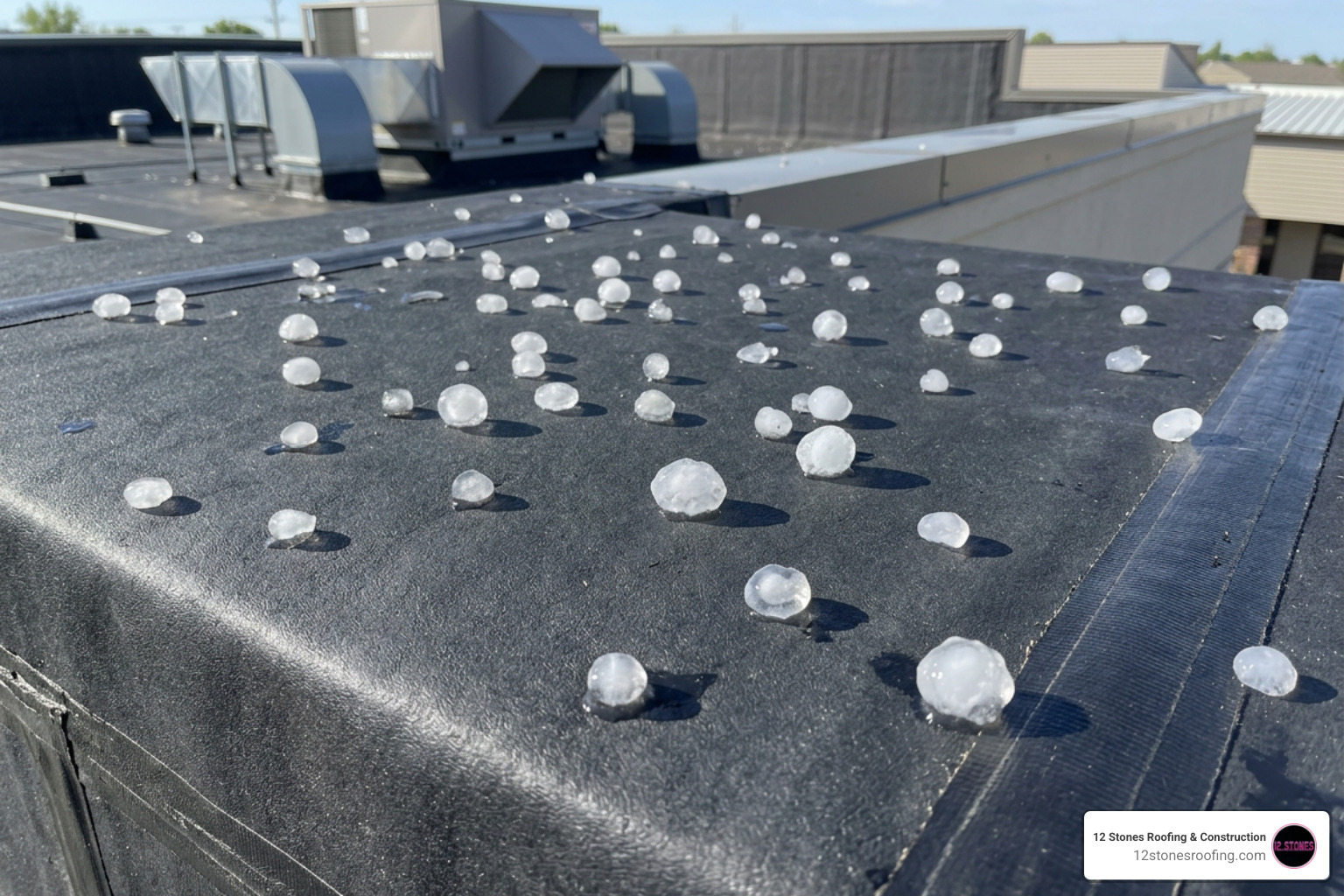
For buildings located in Pasadena, TX and La Porte, TX, severe weather is an annual reality. Hailstorms and high winds carrying flying debris can easily slice through thinner roofing membranes, leading to hidden leaks that rot roof decks and damage inventory.
A 90 mil EPDM membrane provides industry-leading resistance to impact and puncture damage. Because it is a thick, homogeneous rubber layer, it absorbs and dissipates the kinetic energy of falling hail far better than thinner sheets.
The technical specifications of high-end membranes highlight these robust physical properties. For example, the PDS 109 GENFLEX 90-MIL AFR EPDM MEMBRANE.docx data sheet shows that a 90 mil non-reinforced membrane maintains a minimum tensile strength of 1,305 psi (9.0 MPa) and an ultimate elongation of at least 300%. This allows the roof to stretch and flex under impact without fracturing or tearing, even when subjected to large-diameter hail.
Superior Seam Integrity and Weatherproofing
A roof is only as strong as its seams. On a flat roof, seams are subjected to continuous stress from building movement, thermal expansion, and standing water.
90 mil EPDM systems excel in seam performance, especially when paired with modern factory-applied seam tape technology. High-quality products like the JM EPDM NR 90 MIL- FIT feature pre-applied adhesive tape along the edges. This factory-applied tape ensures a highly uniform, vulcanized bond that is far more reliable than hand-welded or field-glued seams.
Furthermore, the vulcanization process used during manufacturing combines two distinct layers of rubber to create a single, fully cross-linked monolithic sheet. This molecular structure gives the membrane exceptional dimensional stability and an incredibly low water absorption rate of just 0.4%, ensuring that ponding water cannot seep into the membrane and degrade the system over time.
Ideal Applications for Heavy-Duty EPDM Systems

Because of its heavy-weight construction and higher initial material cost, a 90 mil EPDM roofing system is typically reserved for environments where standard membranes are likely to fail prematurely. It is the premier choice for low-slope and flat roofs on commercial buildings, industrial facilities, and municipal properties that demand absolute reliability.
High-Traffic Commercial Roofs
If your building’s roof houses heavy HVAC units, refrigeration systems, solar panels, or cellular equipment, it will experience regular foot traffic from maintenance technicians. Every time a technician drops a tool, drags a heavy equipment panel, or sets down a sharp metal ladder, a standard 45 mil or 60 mil roof is at risk of sustaining a puncture.
Installing a 90 mil EPDM membrane provides a thick, rugged barrier that acts as a built-in shield against maintenance-related wear and tear. It eliminates the need for extensive walk-way pads around every piece of equipment, saving installation costs while protecting your building’s interior assets. For industrial owners, choosing a heavy-duty system is a smart operational strategy, as detailed in our guide on how EPDM Rubber Roofing Contractors Will Save Your Assets.
Extreme Weather and Low-Slope Environments
In the Gulf Coast climate of Pasadena and La Porte, commercial roofs must withstand intense UV exposure, extreme summer heat, sudden tropical downpours, and high-wind events. Flat roofs with minimal slope are also prone to ponding water — water that sits on the roof for more than 48 hours after a rainstorm.
While ponding water can accelerate the degradation of some roofing materials, a properly installed 90 mil EPDM system handles standing water exceptionally well due to its seamless installation options and low water permeance. Additionally, its superior thickness provides a massive buffer against the intense solar radiation of Southeast Texas, preventing the membrane from drying out, cracking, or shrinking. To understand the challenges flat roofs face in sunny climates, read about The Not So Sunny Side: Common Problems with EPDM Roofing.
Key Installation Considerations and Best Practices
Installing a thick, heavy-duty 90 mil EPDM membrane requires a high level of precision, specialized equipment, and adherence to strict manufacturer specifications. Because 90 mil rolls are significantly heavier than thinner options — a standard 10′ x 100′ roll of 90 mil non-reinforced EPDM weighs approximately 580 pounds — proper handling and professional installation are non-negotiable. To learn more about the mechanics of a professional installation, read our guide on Window Wizardry: EPDM Membrane Installation Made Easy.
Substrate Preparation and Adhesive Selection
The foundation of a successful EPDM installation lies in the substrate. Before the membrane is unrolled, the roof deck must be completely clean, dry, smooth, and free of sharp edges, loose fasteners, oil, grease, or foreign debris. Any surface voids or gaps in the insulation boards greater than 1/4 inch must be filled with an approved material to prevent the thick rubber from sagging or stressing over time.
For a fully adhered system — which is highly recommended for maximum wind uplift protection in coastal Texas zones — we apply a high-strength bonding adhesive to both the substrate and the underside of the EPDM sheet. The membrane is then rolled carefully into the adhesive to prevent air bubbles, wrinkles, or blisters.
Using a clean, talc-free membrane formulation simplifies this process, as it allows the adhesive to bond directly to the rubber without interference. For precise technical requirements regarding substrate prep and adhesive compatibility, refer to the JM EPDM NR 90 mil Data Sheet.
Seaming, Flashing, and Edge Details
Because 90 mil EPDM is highly robust, detailing around roof penetrations, corners, and edges requires expert craftsmanship. All field seams should be completed using heavy-duty, pressure-sensitive seam tape combined with an approved low-VOC primer. The seams must be rolled with a hand roller to ensure a continuous, watertight bond.
Flashings around pipes, skylights, and HVAC curbs must be integrated using compatible, moldable EPDM flashing details. At the roof perimeter, heavy-gauge edge metal must be secured in accordance with local wind-uplift building codes, and then sealed with a self-adhering cover strip. Paying close attention to these critical transition points is what separates a roof that lasts 15 years from one that easily surpasses 30 years.
Long-Term Value: Cost, Warranties, and Maintenance
While a 90 mil EPDM roofing system requires a larger upfront investment, its long-term financial performance is unmatched. When evaluating commercial roofing options, looking at the total lifecycle cost — rather than just the initial installation price — reveals the true value of a premium, ultra-thick rubber membrane.
Cost and Lifespan of 90 Mil EPDM Roofing
The upfront material cost for a 90 mil EPDM membrane is higher than that of 45 mil or 60 mil membranes. For example, commercial-grade 90 mil rolls can range from several hundred to over two thousand dollars depending on the width, length, and integrated tape features, as shown on 90 mil EPDM Roofing – Flat Roof Solutions.
However, this initial cost is offset by the system’s incredible lifespan. A professionally installed 90 mil EPDM roof routinely lasts over 30 years with minimal repairs.
Furthermore, manufacturers offer their most comprehensive warranties on 90 mil systems. While standard roofs may only qualify for a 15-year warranty, a 90 mil system can easily secure a 30-year manufacturer’s guarantee covering both membrane integrity and workmanship. Over a 30-year period, a building owner with a 90 mil roof will spend significantly less on maintenance, leak repairs, and premature replacement costs compared to an owner who chose a thinner, cheaper alternative.
Preventive Maintenance and Inspection Routines
Even the thickest, most durable roof in the world requires basic care to achieve its maximum lifespan. For a 90 mil EPDM system, we recommend establishing a semi-annual preventive maintenance program.
These inspections should occur in the spring and autumn, as well as immediately following any severe storm events. Key maintenance steps include:
- Debris Removal: Clearing leaves, branches, dirt, and wind-blown trash from the roof surface, gutters, and drains to prevent water blockages.
- Ponding Water Management: Checking that roof drains and scuppers are clear and functioning, ensuring standing water drains off the roof within 48 hours.
- Seam and Flashing Checks: Inspecting the seam edges, pipe penetrations, and perimeter metal for any signs of lifting, cracking, or physical damage.
- Prompt Repairs: Addressing any minor punctures or tears immediately using compatible EPDM patch kits and primers to prevent moisture from reaching the insulation layer.
Partnering with an experienced, local commercial roofing team ensures these inspections are performed safely and thoroughly. For guidance on selecting a trustworthy partner, read our expert tips on How to Pick EPDM Roofing Contractors Who Won’t Leave You High and Dry.
Frequently Asked Questions About 90 Mil EPDM
How long does a 90 mil EPDM roof last?
A 90 mil EPDM roofing system has an expected service life of 30 years or more when properly installed and maintained. Because of its 0.090-inch thickness, it resists weathering, UV radiation, and physical impact far better than standard commercial membranes, meeting or exceeding all ASTM standards for long-term performance.
Can 90 mil EPDM be installed over an existing roof?
In many re-roofing applications, yes. However, this depends entirely on local building codes, the structural load capacity of your building, and the condition of the existing roof system.
Texas building codes generally limit roofs to a maximum of two membrane layers. If the existing roof is saturated with moisture or structurally compromised, it must be torn off down to the deck before the new 90 mil EPDM system can be installed.
Is white EPDM better than black EPDM for Texas climates?
In the hot, sunny climate of Pasadena, TX and La Porte, TX, white EPDM is highly advantageous. While traditional black EPDM absorbs solar heat (which can increase building cooling costs), white EPDM membranes — such as the JM WHITE EPDM NR 90 mil — offer an exceptional initial Solar Reflectance Index (SRI) of 98. This highly reflective surface bounces solar radiation away from the building, keeping the roof surface cool, reducing thermal shock, and significantly lowering summer cooling bills.
Conclusion
When it comes to protecting your commercial or industrial property in Pasadena, TX or La Porte, TX, compromising on your roofing material is a risk you cannot afford to take. A 90 mil EPDM roofing system represents the absolute peak of single-ply rubber durability, offering unmatched puncture resistance, exceptional weatherproofing, and a reliable 30-year service life that easily outlasts thinner alternatives.
At 12 Stones Roofing & Construction, we specialize in delivering heavy-duty, high-performance commercial roofing systems tailored to withstand the harsh realities of the Texas Gulf Coast. As a Service-Disabled Veteran-Owned local business, we pride ourselves on absolute transparency, military-grade discipline, and craftsmanship that stands the test of time.
Ready to secure your building with a premium, long-lasting roof? Contact our team today for expert EPDM roofing solutions and let us help you protect your assets for decades to come. Call us directly at 281-555-0199 to schedule your professional commercial roof assessment.