
Why 45 Mil EPDM Rubber Roofing Is a Top Choice for Flat Roofs in 2026
Choosing the right 45 mil EPDM rubber roofing product is one of the most important decisions you’ll make for a flat or low-slope roof — and with dozens of roll sizes, widths, and suppliers available, the options can feel overwhelming fast. At 12 Stones Roofing & Construction, we provide expert guidance and professional installation to ensure your property remains fully protected against the elements.
Here’s a quick snapshot to help you compare at a glance:
| Feature | Details |
|---|---|
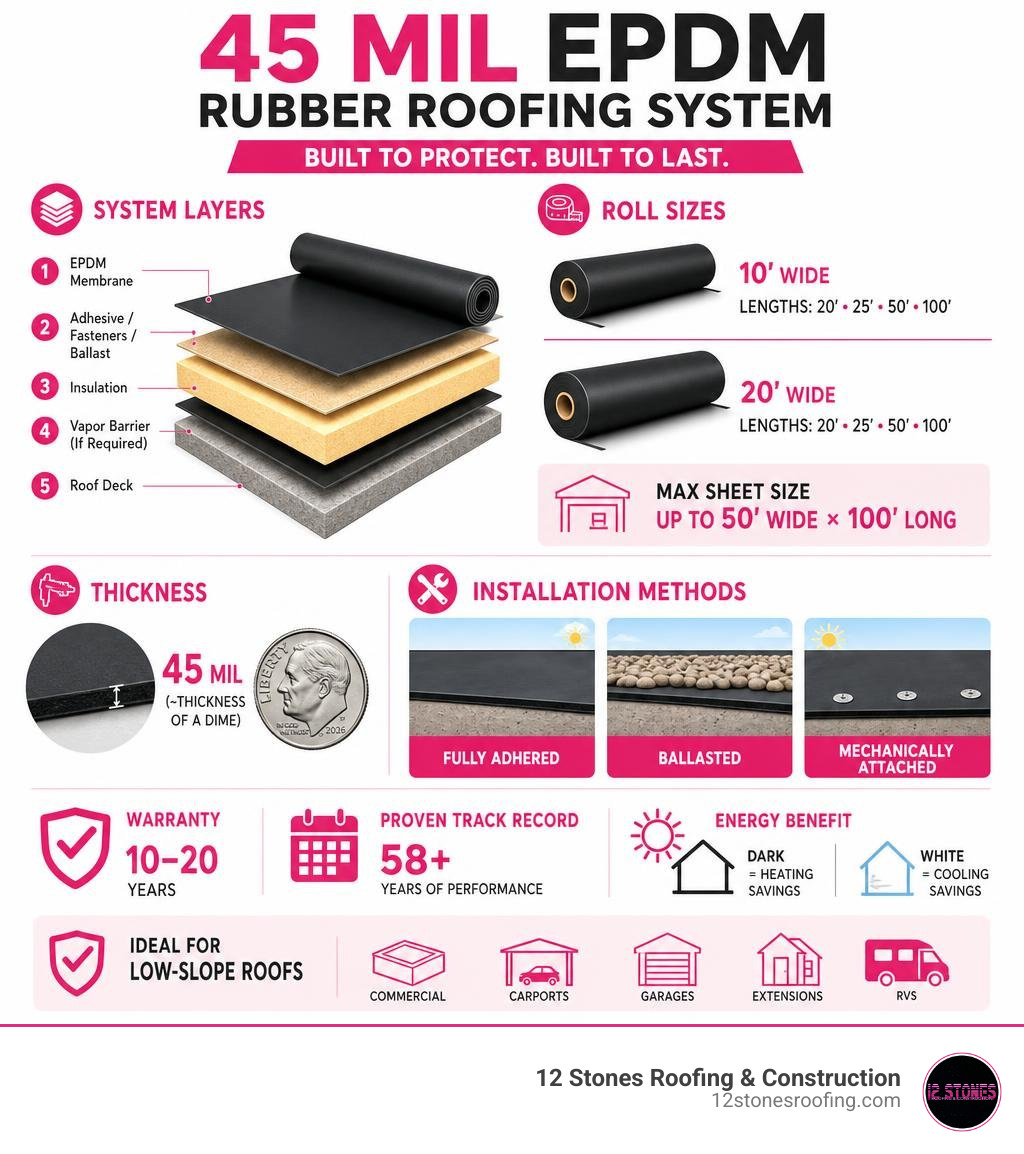
| Thickness | 45 mil (~thickness of a dime) |
| Max sheet size | Up to 50′ wide × 100′ long |
| Installation methods | Fully adhered, ballasted, mechanically attached |
| Best for | Low-slope roofs, carports, garages, extensions, RVs |
| Typical warranty | 10–20 years |
| Proven track record | 58+ years of performance history |
| Energy benefit | Dark = heating savings; White = cooling savings |
EPDM — short for ethylene propylene diene terpolymer — is a synthetic rubber membrane that has been protecting buildings for over 58 years. It’s trusted on billions of square feet of roofing worldwide because it handles UV radiation, ozone, extreme cold, and harsh weather better than most alternatives. At 45 mil thick, it’s the standard entry-level commercial grade: thin enough to keep costs manageable, yet tough enough for real-world conditions across a wide range of climates — including the punishing heat and storm cycles of the Gulf Coast.
If you’re weighing your flat roofing options after storm damage or an aging roof, our EPDM roofing services at 12 Stones Roofing & Construction can help you find the right solution for your property.
I’m Jason Roberts, owner of 12 Stones Roofing & Construction, a Service-Disabled Veteran-Owned firm based in Pasadena, Texas, with over a decade of hands-on experience installing and specifying 45 mil EPDM rubber roofing on both residential and commercial projects across the Gulf Coast region. In this guide, I’ll walk you through the most popular roll sizes, specs, and options available in June 2026 so you can make a confident, informed choice.
Basic 45 mil epdm rubber roofing glossary:
What is 45 Mil EPDM Rubber Roofing and How Does It Compare?
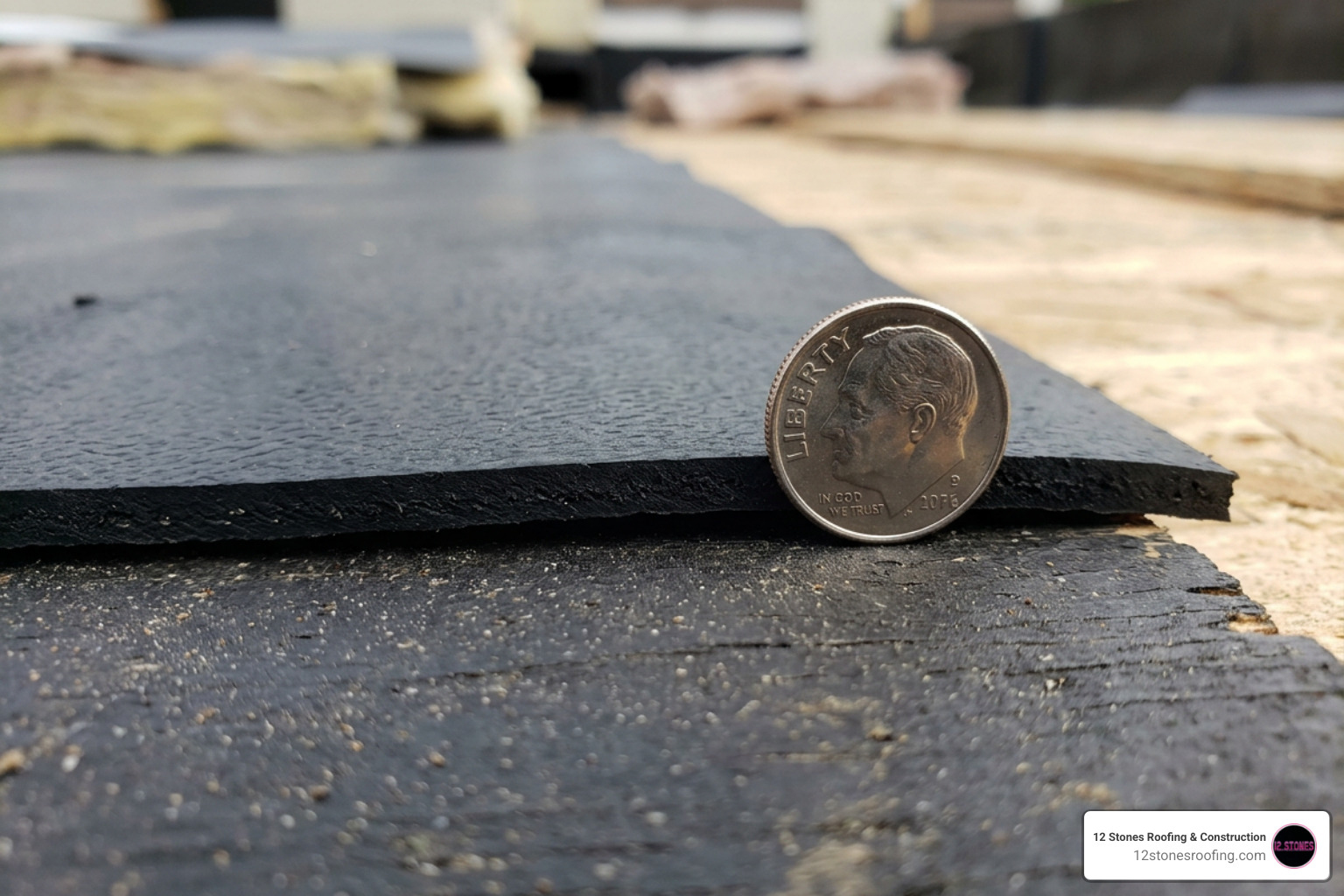
When we talk about “mil” thickness in the roofing industry, we are not talking about millimeters. One mil is equal to one-thousandth of an inch (0.001 inch). Therefore, a 45 mil EPDM rubber roofing membrane is exactly 0.045 inches thick—which is approximately the thickness of a standard United States dime.
In the single-ply roofing market, EPDM membranes are typically offered in two primary thicknesses: 45 mil and 60 mil. Deciding between these two options depends on your specific project needs, budget, and foot traffic expectations. To help you evaluate if Is 45 Mil EPDM Rubber the Right Fit for Your Roof?, let’s look at how they stack up side-by-side.
| Property / Feature | 45 Mil EPDM Membrane | 60 Mil EPDM Membrane |
|---|---|---|
| Physical Thickness | 0.045 inches (approx. a dime) | 0.060 inches (approx. a quarter) |
| Average Weight | Approx. 0.29 lbs/sq. ft. | Approx. 0.39 lbs/sq. ft. |
| Puncture Resistance | Standard (suitable for light maintenance access) | High (better for frequent foot traffic or hail) |
| Material Cost | Economical and budget-friendly | 20% to 30% more expensive than 45 mil |
| Typical Lifespan | 15 to 20+ years | 25 to 30+ years |
| Flexibility | Extremely pliable, easy to detail | Slightly stiffer, requires more effort on tight corners |
For most standard low-slope applications, a 45 mil non-reinforced membrane provides an outstanding balance of cost and performance. Because it is highly elastomeric, it expands and contracts seamlessly with building movement and temperature swings without cracking. While 60 mil offers superior puncture resistance, 45 mil remains the go-to standard for residential additions, detached garages, and light commercial buildings where active rooftop foot traffic is minimal.
Key Benefits of 45 Mil EPDM Rubber Roofing
Understanding the material science behind EPDM helps explain why it has remained a industry staple for nearly six decades. When you read The EPDM Story: Everything You Need to Know About This Versatile Material, you realize it is engineered to survive the absolute worst atmospheric conditions.
- Exceptional UV and Ozone Resistance: EPDM is an inert material that does not degrade under intense ultraviolet radiation. This is a critical factor for roofs in Pasadena and La Porte, Texas, where the summer sun beats down relentlessly day after day.
- Low-Temperature Flexibility: With a brittleness temperature of -67°F (-55°C), EPDM will not crack or become brittle in freezing winter conditions. It retains its rubber-like elasticity across all seasons.
- Thermal Shock Compensation: Because the material has an elongation capacity exceeding 400%, it easily absorbs the rapid temperature changes that occur when a sudden Texas thunderstorm cools a hot rooftop by 40 degrees in a matter of minutes.
- Energy Efficiency Savings: EPDM is highly adaptable to energy-saving goals. Traditional black EPDM helps building owners in colder climates save on heating costs by absorbing solar warmth. Conversely, white-on-black EPDM (such as Mule-Hide’s cool roof options) features a highly reflective white top surface with an Initial Solar Reflectance of 0.76 and a Solar Reflectance Index (SRI) of 94, dramatically lowering cooling costs during hot Texas summers.
- Eco-Friendly and Recyclable: EPDM has a low environmental impact during manufacture and is fully recyclable at the end of its long service life, making it a highly sustainable single-ply choice.
Ideal Applications for 45 Mil Membranes
While commercial warehouses frequently utilize EPDM, 45 mil membranes are highly versatile and ideal for a wide variety of low-slope and flat residential and light commercial structures. According to our EPDM Roofing Complete Guide, some of the best applications include:
- Residential Room Additions & Sunrooms: Perfect for flat-roofed home extensions where seamless water protection is required.
- Detached Garages & Carports: Provides a highly reliable, low-maintenance barrier that protects vehicles and equipment.
- Storage Buildings & Sheds: An easy-to-install option that vastly outperforms traditional felt or roll roofing.
- Porches, Breezeways, & Verandas: Keeps transition spaces dry and protected from heavy downpours.
- Mobile Homes & RV Roofs: The lightweight nature of 45 mil EPDM (only 0.29 lbs per square foot) makes it a preferred choice for recreational vehicles and manufactured housing.
Comparing Popular 45 Mil EPDM Roll Sizes and Specifications
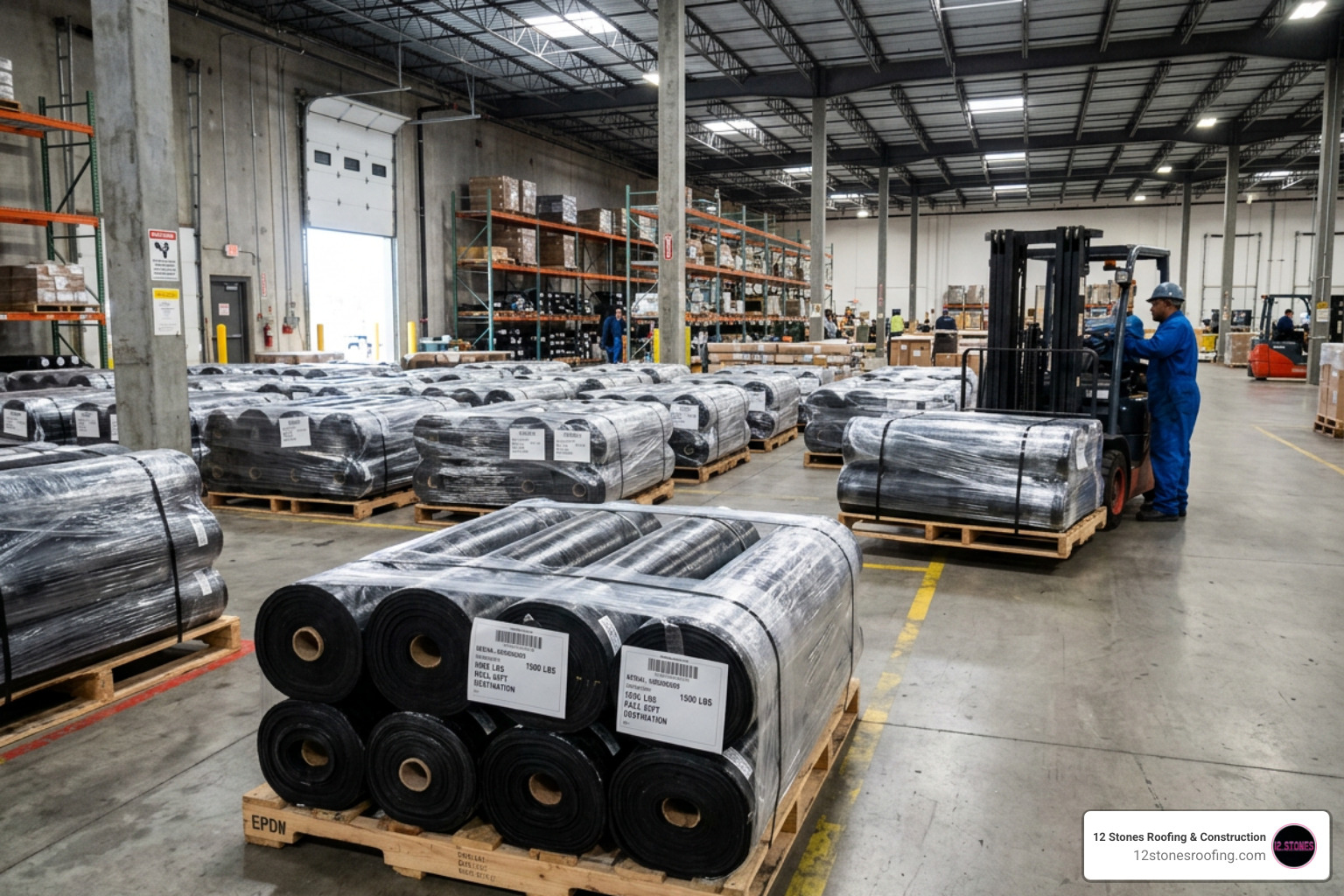
One of the greatest advantages of EPDM is that it is manufactured in massive sheets. This allows for a nearly seamless installation on many flat roof designs. Minimizing seams is the single best way to prevent future leaks, as seams are historically the most common point of failure on any flat roof.
When ordering EPDM Rubber Roofing Materials, you must carefully evaluate the roll sizes to match your roof’s geometry while keeping shipping and handling constraints in mind. EPDM is incredibly dense and heavy, meaning large rolls require freight shipping (LTL) and mechanical lifting equipment on-site.
Standard Sizes and Options for 45 Mil EPDM Rubber Roofing
For residential and light commercial projects, manufacturers package EPDM in highly manageable, pre-cut roll sizes. These are perfect for DIYers or smaller professional installations:
- 15′ x 25′ Rolls: Weighing approximately 158 lbs, the EPDM Roofing Membrane 45 MIL – 15′ x 25′ is an excellent choice for small residential porches, carports, and shed roofs. It provides 375 square feet of seamless coverage.
- 20′ x 50′ Rolls: Weighing around 330 lbs, the EPDM Roofing Membrane 45 MIL – 20′ x 50′ offers 1,000 square feet of coverage. It is ideal for larger room additions, double garages, and small commercial storefronts.
- 10′ x 100′ Rolls: Weighing about 320 lbs, this long, narrow configuration is commonly used for commercial corridors, wide gutters, or modular building sections. It is a staple of fully-adhered commercial systems.
- Custom Cuts: Many specialty suppliers, such as those providing 45 MIL EPDM RUBBER ROOFING – American Material Supply, allow customers to order custom-cut lengths to minimize waste and avoid paying for excess material.
Large-Scale Commercial Roll Options
For massive industrial and commercial roofs, standard retail sizes simply won’t cut it. To maximize installation speed and eliminate seams entirely across wide spans, commercial-grade rolls are available in expansive dimensions:
- 25′ Wide Rolls: Products like the EPDM 45 Mil Black Rubber Roofing 25′ Wide allow crews to cover substantial areas with a single pull, reducing labor costs and seam-taping time on mid-sized commercial properties.
- 30′ Wide Rolls: For even larger footprints, EPDM 45 Mil Black Rubber Roofing 30′ Wide – Flatroof Universe rolls are deployed. These massive membranes are typically installed using professional crane or forklift equipment due to their extreme weight.
- Up to 50′ x 100′ Sheets: The largest manufactured sheets can cover up to 5,000 square feet in a single piece. While highly efficient, handling sheets of this size requires an experienced, well-coordinated professional roofing crew.
Installation Methods and Essential Accessories
EPDM is incredibly versatile when it comes to how it can be secured to a roof deck. Depending on the building’s structural capacity, wind uplift requirements, and budget, there are three primary installation methods outlined in the technical Installation/Application Datasheet:
- Fully Adhered System: The membrane is glued directly to the substrate (such as polyisocyanurate insulation boards or suitable plywood/OSB decking) using a high-strength bonding adhesive. This is the most wind-resistant and aesthetically clean method. It is highly recommended for residential and light commercial roofs in hurricane-prone zones like Pasadena and La Porte.
- Mechanically Attached System: The EPDM sheet is laid loose over the substrate and secured using heavy-duty screws and plates along the seams. The seams are then sealed over with seam tape. This is a fast, cost-effective method for steel or wood decks that can handle mechanical fasteners.
- Ballasted System: The membrane is laid loose over the substrate, sealed at the seams, and held in place using a heavy layer of smooth river stone ballast or concrete pavers. While highly economical and quick to install, it adds significant weight to the structure, making it unsuitable for most standard residential roofs.
For a detailed look at how these membranes are detailed around tricky areas like skylights and parapet walls, check out our guide on Window Wizardry: EPDM Membrane Installation Made Easy.
Required Installation Accessories
Installing 45 mil EPDM rubber roofing requires a complete system of specialized accessories. You cannot simply buy the rubber roll and nail it down. To ensure a completely watertight system that meets the standards of a professional PRODUCT DATA SHEET, you will need:
- EPDM Bonding Adhesive: A contact-strength adhesive applied to both the underside of the membrane and the substrate. Once it becomes tacky, the membrane is rolled into place.
- EPDM Primer: A chemical preparation agent applied to the rubber surface before seaming or flashing. The primer activates the rubber, allowing the tape to form a chemical weld.
- Double-Sided Seam Tape: A highly tacky, butyl-based tape used to fuse two overlapping EPDM sheets together.
- Uncured Flashing Tape: Highly malleable rubber tape used to detail inside and outside corners, pipe boots, and T-joints where standard flat tape cannot conform.
- Lap Sealant: A thick, paste-like sealant applied along the exposed edges of completed seams and flashing details to provide a secondary line of defense against moisture.
- Silicone Hand Roller: Used to apply firm, even pressure over all taped seams and flashings to ensure 100% adhesion and eliminate air pockets.
Common Installation Pitfalls to Avoid
While EPDM is highly reliable, it is unforgiving of poor installation techniques. If you’re planning a project, you must watch out for the typical issues discussed in The Not So Sunny Side: Common Problems with EPDM Roofing:
- Trapped Wrinkles and Creases: EPDM arrives tightly rolled and folded. If you do not unroll the membrane and let it “relax” on the roof deck for at least 30 to 45 minutes (longer in cold weather) before adhering, it will develop permanent wrinkles that can restrict water flow.
- Moisture on the Substrate: Adhesives and primers will fail if applied to damp wood or concrete. The roof deck must be completely dry. Never attempt to install EPDM in the rain or when heavy dew is present.
- Ignoring Temperature Limits: Solvent-based bonding adhesives should not be applied if temperatures are expected to drop below 40°F (5°C) within 24 hours of application, as this prevents proper curing.
- Poor Substrate Preparation: Debris, old nails, or rough felt paper will puncture a 45 mil membrane underfoot. The substrate must be swept clean, smooth, and free of sharp edges. If the old decking is damaged or uneven, we strongly recommend overboarding the roof with a minimum of 10mm OSB or plywood before applying adhesive.
Frequently Asked Questions About EPDM Thickness and Performance
How long does a 45 mil EPDM roof last?
When properly installed and maintained, a 45 mil EPDM rubber roof has a service life expectancy of up to 50 years. While the raw synthetic rubber membrane itself is incredibly durable, the overall system’s lifespan is typically limited by the seams and flashing details.
Most manufacturers offer a 10-to-20-year limited warranty against material weathering failures, as seen on the heavy-duty TRC EPDM Membrane 045 1.2mm | RubbaSeal. Regular inspections and minor seam maintenance around the 15-year mark can easily extend the roof’s life well beyond two decades.
Can you walk on a 45 mil EPDM rubber roof?
Yes, a 45 mil EPDM roof is tough enough to handle light foot traffic for routine maintenance, such as cleaning gutters, servicing HVAC units, or inspecting the roof. However, it is not designed to serve as an active recreational deck, balcony, or high-traffic walkway.
As noted in the EPDM Rubber Roofing Materials Discussion, if your roof requires frequent access, you should install heavy-duty EPDM walkway pads or protect the membrane with timber decking, paving slabs, or a sand-and-cement screed layer to prevent accidental punctures from tools or dropped objects.
What is the difference between reinforced and non-reinforced EPDM?
Non-reinforced EPDM (ASTM D4637 Type I) is a single, homogenous sheet of synthetic rubber. It offers maximum elasticity (over 400% elongation), allowing it to stretch easily around complex roof details, pipe penetrations, and corners. This makes it highly popular for residential and modular buildings.
Reinforced EPDM contains an embedded polyester scrim or fiberglass mesh layer. This internal reinforcement drastically increases the membrane’s tear and puncture resistance, making it ideal for mechanically attached commercial systems where wind forces pull hard on the fasteners. However, reinforced EPDM is stiffer and much harder to mold around tight corners and roof penetrations. To ensure your system is designed correctly, know How to Pick EPDM Roofing Contractors Who Won’t Leave You High and Dry.
Conclusion
A 45 mil EPDM rubber roofing system represents one of the most reliable, cost-effective, and long-lasting flat roofing solutions available in June 2026. Whether you are protecting a residential room addition, a detached garage, or a commercial storefront in Pasadena or La Porte, EPDM’s 58-year track record of weather resistance and flexibility makes it an outstanding investment.
While DIY kits are available for simple, small structures, larger flat roofs require professional precision. A single poorly sealed seam or an improperly detailed corner can lead to costly interior water damage. Hiring experienced professionals ensures that your membrane is installed with proper substrate preparation, correct adhesive application, and flawless commercial-grade flashing details.
At 12 Stones Roofing & Construction, we specialize in high-quality flat roof installations designed to withstand the brutal heat, high winds, and severe storms of the Texas Gulf Coast. We bring local expertise, transparent pricing, and military-grade discipline to every roofing project. Protecting your property is our top priority, and choosing the right team is the first step—because as we like to say, EPDM Rubber Roofing Contractors Will Save Your Assets.
Ready to upgrade your flat roof with a durable, professionally installed EPDM membrane? Visit our website to Get a Professional EPDM Installation Quote and let’s build a roof that stands the test of time together!